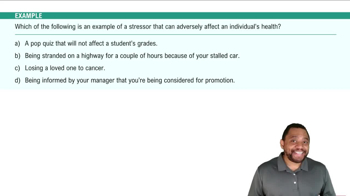
Is it true that an individual will only feel stress in negative situations?
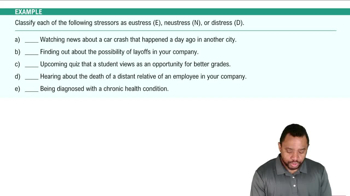
No, individuals can feel stress in both positive and negative situations. Positive events, such as planning a wedding, can also cause stress, known as eustress.
Stress is __________.
Stress is a psychological and physiological response to events perceived as challenging or overwhelming.
What are events that provoke stress called?
Events that provoke stress are called stressors.
What is the positive dimension of stress called?
The positive dimension of stress is called eustress.
What does the amount of stress you experience mostly relate to?
The amount of stress you experience mostly relates to your personal perception of the event or situation.
Eustress is a type of what kind of stress?
Eustress is a type of positive stress.
Stress caused by procrastination is an example of what type of stress?
Stress caused by procrastination is an example of distress, which is negative stress.
Eustress is a type of what kind of stress?
Eustress is a type of positive stress.
What are the three main types of stress?
The three main types of stress are eustress (positive), distress (negative), and neustress (neutral).
What is the most common type of physical stress?
The most common type of physical stress is acute stress, which is short-term and intense.
What is the meaning of the Latin root of the word 'stress'?
The Latin root of 'stress' refers to 'strictus,' meaning 'drawn tight.'
How is stress different from strain?
Stress is the body's response to a perceived challenge or demand, while strain is the effect or outcome of that stress on the body or mind.
How are stressors different from stress?
Stressors are the events or stimuli that cause stress, while stress is the body's response to those events or stimuli.
Is stress the body's automatic physical reaction to real or imagined forces?
Yes, stress is the body's automatic psychological and physiological reaction to real or perceived challenges.
What is positive, short-term, motivating, and inspiring stress called?
Positive, short-term, motivating, and inspiring stress is called eustress.
Can buying a new house increase one's stress level?
Yes, buying a new house can increase one's stress level, as major life changes are common stressors.
What is a main reason why entrepreneurs experience daily stress?
Entrepreneurs experience daily stress due to work-related pressures, such as deadlines, expectations, and the need to be productive.
What is stress?
Stress is a psychological and physiological response to events perceived as challenging or overwhelming, affecting multiple dimensions of health.
What is the type of stress that causes negative emotions?
The type of stress that causes negative emotions is called distress.
Caregiver stress is also known as what?
Caregiver stress is also known as chronic stress, as it often persists over a long period.
What is stress according to the Everfi curriculum?
Stress is a psychological and physiological response to perceived challenges, impacting physical, mental, emotional, and social health.
What are some common warning signs of stress?
Common warning signs of stress include headaches, racing heart, anxiety, irritability, impulsiveness, and social withdrawal.
How is chronic boredom a form of stress?
Chronic boredom can be a form of stress because it represents a persistent state of dissatisfaction or lack of stimulation, which can negatively impact mental and emotional health.
What are some common sources of stress in everyday life?
Common sources of stress include relationships, illness, academic pressures, work, economic factors, and political issues.
How does stress impact different dimensions of health?
Stress impacts physical health (e.g., headaches), mental health (e.g., anxiety), emotional health (e.g., irritability), and social health (e.g., isolation).
How does the perception of an event influence the level of stress experienced?
The perception of an event influences the level of stress experienced because what is stressful for one person may not be stressful for another, depending on individual interpretation.
What is the difference between acute and chronic stress?
Acute stress is short-term and intense, while chronic stress is long-term and can have severe health implications.
 Back
Back



 1:44
1:44