An angular collision occurs when at least one object is rotating or begins to rotate as a result of the collision.
When should you use conservation of angular momentum instead of linear momentum?
Use conservation of angular momentum whenever any rotational motion (omega) is involved in the collision.
What is the general equation for conservation of angular momentum in angular collisions?
The equation is I1*Omega1_initial + I2*Omega2_initial = I1*Omega1_final + I2*Omega2_final, where I is moment of inertia and Omega is angular velocity.
How do you calculate angular momentum for a point mass in linear motion colliding with a rotating body?
Use L = m*v*r, where m is mass, v is velocity, and r is the distance from the axis of rotation.
What happens to the angular speed of a rotating disc when a non-spinning disc is placed on top of it?
The angular speed (RPM) of the system decreases because the added mass increases the moment of inertia.
How do you convert RPM to angular velocity (omega)?
Use omega = 2π*RPM/60 to convert RPM to angular velocity in radians per second.
What is the effect of adding a disc spinning in the opposite direction to a rotating disc?
The final RPM of the system will be lower than if the added disc was at rest, because the opposite rotation cancels out some of the original angular momentum.
In angular collision problems, what does 'completely inelastic' mean?
It means that after the collision, the objects rotate together with the same angular speed.
What is the formula for the moment of inertia of a solid disc?
The moment of inertia is I = (1/2) * m * r^2, where m is mass and r is radius.
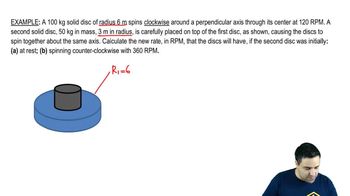
If a disc of mass 100 kg and radius 6 m spins at 120 RPM, what is its moment of inertia?
Its moment of inertia is I = (1/2) * 100 * 6^2 = 1800 kg·m^2.
What is the final RPM when a 100 kg, 6 m disc spinning at 120 RPM has a 50 kg, 3 m disc at rest placed on top?
The final RPM is -107, indicating the system spins clockwise but slower than before.
How do you set up the conservation of angular momentum equation when two discs spin together after collision?
Set I1*Omega1_initial + I2*Omega2_initial = (I1 + I2)*Omega_final, since both discs rotate together after collision.
What is the final RPM when the second disc is spinning at 360 RPM counterclockwise before being placed on the first disc?
The final RPM is -67, meaning the system spins clockwise but much slower due to the opposite rotation.
Why does the system's RPM decrease more when the added disc spins in the opposite direction?
Because the angular momentum of the second disc opposes that of the first, reducing the total angular momentum and thus the final RPM.
What does the direction of rotation (clockwise or counterclockwise) indicate in angular collision calculations?
It determines the sign of angular velocity or RPM; clockwise is negative and counterclockwise is positive.
 Back
Back

 15:21
15:21