Back

Capacitance Using Calculus quiz

Control buttons has been changed to "navigation" mode.
1/15
  • What is the formula for capacitance in terms of charge and potential difference?

    Capacitance is defined as the charge divided by the potential difference, C = q/V.
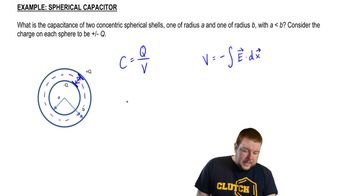
  • What are the radii of the two concentric spherical shells in the example?

    The inner shell has radius a and the outer shell has radius b, with a < b.
  • What is the charge considered on each sphere in the example?

    Each sphere is considered to have a charge of plus or minus q.
  • Which law tells us that the electric field between the shells is only due to the inner sphere?

    Gauss's law tells us that the electric field between the shells is only due to the inner sphere.
  • What is the expression for the electric field between the two spherical shells?

    The electric field is kq/r^2 in the radial direction between the shells.
  • What integral is used to find the potential difference between the shells?

    The potential difference is found using the integral of the electric field dotted into dr from a to b.
  • What is the result of integrating kq/r^2 from a to b?

    The result is kq(1/b - 1/a).
  • How can kq(1/b - 1/a) be rewritten with a common denominator?

    It can be rewritten as kq(a - b)/(ab).
  • How is the capacitance calculated from the charge and potential difference?

    Capacitance is calculated as q divided by the potential difference, so C = q/(kq(a - b)/ab).
  • What happens to the q terms when calculating capacitance?

    The q terms cancel out, simplifying the expression.
  • What is the simplified formula for capacitance after canceling q?

    The formula becomes C = ab/(k(a - b)).
  • What is the value of k in terms of fundamental constants?

    k is equal to 1/(4πϵ₀), where ϵ₀ is the permittivity of free space.
  • What is the final formula for the capacitance of two concentric spherical shells?

    The final formula is C = 4πϵ₀ ab/(a - b).
  • Why do most books write the capacitance formula with ab/(a - b)?

    Because it is a standard form that simplifies the relationship between the radii and capacitance.
  • What direction is considered when integrating the electric field for potential difference?

    The radial direction (r direction) is considered when integrating the electric field.