Back

Calorimetry with Temperature and Phase Changes quiz

Control buttons has been changed to "navigation" mode.
1/15
  • What is the main difference between calorimetry problems involving only temperature changes and those involving phase changes?

    Problems with phase changes require accounting for both temperature changes and the energy needed for the phase transition, using latent heat.
  • What equation is used to relate the heat gained and lost in a calorimetry problem?

    The equation used is QA = -QB, where QA is the heat gained by one substance and QB is the heat lost by the other.
  • What does the term 'latent heat of fusion' refer to in calorimetry?

    Latent heat of fusion is the energy required to change a substance from solid to liquid at its melting point without changing its temperature.
  • How do you calculate the heat required for a temperature change in a substance?

    Use the equation Q = mcΔT, where m is mass, c is specific heat capacity, and ΔT is the temperature change.
  • How do you calculate the heat required for a phase change?

    Use the equation Q = mL, where m is the mass undergoing the phase change and L is the latent heat for that phase transition.
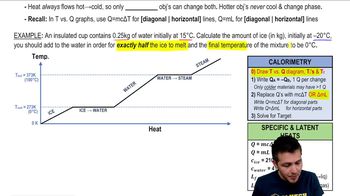
  • In the example, what is the initial temperature of the water and the ice?

    The water starts at 15°C and the ice starts at -20°C.
  • What is the final temperature aimed for in the example problem?

    The final temperature is 0°C.
  • Why are there two separate heat calculations (QA1 and QA2) for the ice in the example?

    QA1 accounts for heating the ice to 0°C, and QA2 accounts for melting half of the ice at 0°C.
  • What does the variable Δm represent in the context of phase change calculations?

    Δm represents the mass of the substance that actually undergoes the phase change, which may be only part of the total mass.
  • Which specific heat capacities are used for the ice and water in the example?

    The specific heat capacity for ice is 2110 J/kg·°C, and for water it is 4186 J/kg·°C.
  • What is the value of the latent heat of fusion used for ice in the example?

    The latent heat of fusion for ice is 3.34 × 10^5 J/kg.
  • Why does only the colder material (ice) undergo both temperature and phase changes in this problem?

    Because heat flows from hot to cold, only the colder material can both warm up and change phase, while the hotter material only cools down.
  • How is the mass of ice that melts related to the total mass of ice in the example?

    Only half of the total mass of ice melts, so Δm = 0.5 × total mass of ice.
  • What is the final calculated mass of ice needed to achieve the desired conditions in the example?

    The mass of ice needed is approximately 0.075 kilograms.
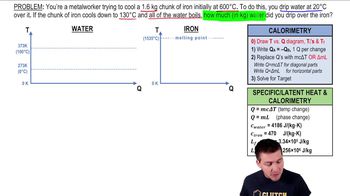
  • What is the purpose of drawing a temperature versus heat (q) diagram in calorimetry problems?

    It helps visualize the temperature and phase changes, and identify the steps and heat calculations needed for the problem.