Back

Completely Inelastic Collisions quiz

Control buttons has been changed to "navigation" mode.
1/15
  • What is a completely inelastic collision?

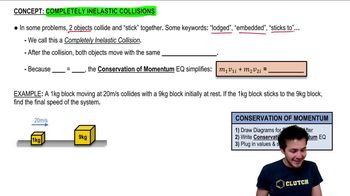
    A completely inelastic collision is when two objects collide and stick together, moving with the same final velocity.
  • What are some keywords that indicate a completely inelastic collision?

    Keywords include 'lodged', 'embedded', and 'sticks to'.
  • After a completely inelastic collision, how do the velocities of the two objects compare?

    Both objects move together with the same final velocity.
  • In the example, what are the masses of the two blocks involved in the collision?

    The first block has a mass of 1 kg and the second block has a mass of 9 kg.
  • What is the initial velocity of the 1 kg block in the example?

    The initial velocity of the 1 kg block is 20 m/s.
  • What is the initial velocity of the 9 kg block in the example?

    The 9 kg block is initially at rest, so its velocity is 0 m/s.
  • What is the total mass of the system after the collision in the example?

    The total mass is 10 kg, which is the sum of both blocks' masses.
  • What principle is used to solve for the final velocity in a completely inelastic collision?

    The conservation of momentum is used to solve for the final velocity.
  • Write the general equation for conservation of momentum for two objects before and after a collision.

    The equation is m1v1_initial + m2v2_initial = (m1 + m2)v_final.
  • What is the final velocity of the combined blocks in the example?

    The final velocity is 2 m/s.
  • Why does the velocity decrease from 20 m/s to 2 m/s after the collision in the example?

    The velocity decreases because the mass increases by a factor of 10, so the speed must decrease by a factor of 10 to conserve momentum.
  • How do you combine the masses in a completely inelastic collision when solving for final velocity?

    You add the masses together since the objects move as one combined mass after the collision.
  • If two objects stick together after a collision, what type of collision is it?

    It is a completely inelastic collision.
  • What happens to the total momentum of the system during a completely inelastic collision?

    The total momentum of the system is conserved.
  • In the example, what would happen to the final velocity if the combined mass was larger?

    If the combined mass was larger, the final velocity would be smaller to conserve momentum.