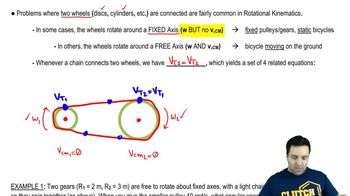
What is the key relationship between tangential velocities of two wheels connected by a chain or belt?
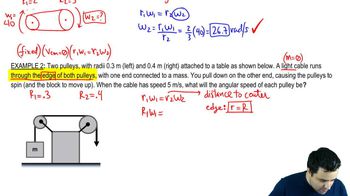
The tangential velocity at the edge of one wheel equals the tangential velocity at the edge of the second wheel when connected by a chain or belt.
How is tangential velocity (VT) related to radius (R) and angular velocity (omega)?
Tangential velocity is given by VT = R * omega, where R is the radius and omega is the angular velocity.
What happens to the angular speed of a wheel if its radius increases, assuming tangential velocity is constant?
The angular speed decreases as the radius increases, since they are inversely related for constant tangential velocity.
What is the fundamental equation for two connected wheels regarding their radii and angular speeds?
The fundamental equation is R1 * omega1 = R2 * omega2.
How does the angular speed of a smaller wheel compare to a larger wheel when both are connected and rotating?
The smaller wheel spins faster (higher angular speed) than the larger wheel.
What are the four quantities that can describe how quickly a wheel spins?
The four quantities are angular velocity (omega), frequency (f), period (T), and RPM.
How can the fundamental equation for connected wheels be rewritten using frequency?
It can be rewritten as R1 * f1 = R2 * f2.
How can the fundamental equation for connected wheels be rewritten using period?
It can be rewritten as R1 / T1 = R2 / T2.
How can the fundamental equation for connected wheels be rewritten using RPM?
It can be rewritten as R1 * RPM1 = R2 * RPM2.
What is the tangential velocity at the edge of a wheel rotating around a fixed axis?
It is given by VT = R * omega, where R is the radius and omega is the angular velocity.
In a system of two connected wheels, what remains constant along the chain or belt?
The tangential velocity remains constant along the chain or belt.
What is the center of mass velocity for wheels rotating around a fixed axis?
The center of mass velocity is zero; the wheels do not move sideways.
If a small gear of radius 2 rotates at 40 radians per second and is connected to a larger gear of radius 3, what is the angular speed of the larger gear?
The angular speed of the larger gear is (2/3) * 40 = 26.7 radians per second.
What is the effect of connecting two wheels of different sizes with a chain or belt on their angular speeds?
The wheel with the smaller radius will have a higher angular speed, while the larger wheel will have a lower angular speed.
Why is it important to know all four variations of the fundamental equation for connected wheels?
Knowing all four variations allows you to quickly solve problems involving connected rotating objects using whichever quantity is provided.
 Back
Back


 03:41
03:41