Skip to main content
Physics with Calculus
My Course
Learn
Exam Prep
AI Tutor
Study Guides
Textbook Solutions
Flashcards
Explore
Try the app
My Course
Learn
Exam Prep
AI Tutor
Study Guides
Textbook Solutions
Flashcards
Explore
Try the app
Back
Cyclic Thermodynamic Processes quiz
You can tap to flip the card.
What is a cyclic thermodynamic process?
You can tap to flip the card.
👆
What is a cyclic thermodynamic process?
A cyclic thermodynamic process is one in which a system returns to its initial state after a sequence of steps.
Track progress
Control buttons has been changed to "navigation" mode.
1/15
Related flashcards
Related practice
Recommended videos
Cyclic Thermodynamic Processes definitions
Cyclic Thermodynamic Processes
15 Terms
Cyclic Thermodynamic Processes
22. The First Law of Thermodynamics
5 problems
Topic
Patrick
PV Diagrams & Work
22. The First Law of Thermodynamics
3 problems
Topic
Patrick
22. The First Law of Thermodynamics
5 topics
13 problems
Chapter
Patrick
Guided course
03:26
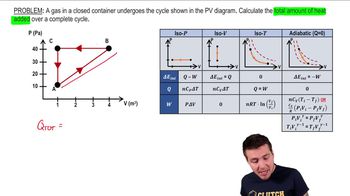
Heat Added Over Complete Cycle
2233
views
24
rank
Guided course
05:31
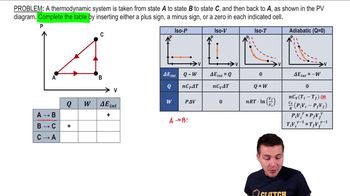
Signs in a Three-Step Cyclic Process
2855
views
15
rank
Guided course
08:45
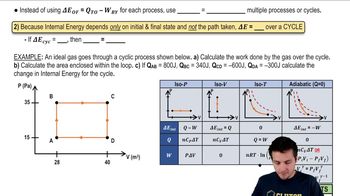
Properties of Cyclic Thermodynamic Processes
3645
views
31
rank
3
comments
Terms in this set (15)
Hide definitions
What is a cyclic thermodynamic process?
A cyclic thermodynamic process is one in which a system returns to its initial state after a sequence of steps.
How is the total work done in a cyclic process represented on a PV diagram?
The total work done is equal to the area enclosed within the loop on the PV diagram.
What is the work done during an isovolumetric process?
The work done is zero because there is no change in volume during an isovolumetric process.
How do you calculate work done in an isobaric process?
Work is calculated using the formula W = P * ΔV, where P is pressure and ΔV is the change in volume.
If a cyclic process is traversed clockwise on a PV diagram, what is the sign of the work done?
The work done is positive if the loop is traversed clockwise.
What happens to the sign of the work done if the loop is traversed counterclockwise?
The work done is negative if the loop is traversed counterclockwise.
What is the change in internal energy (ΔE) for a complete cyclic process?
The change in internal energy is zero because the system returns to its initial state.
How is the total heat transfer in a cyclic process related to the total work done?
The total heat transfer equals the total work done when the change in internal energy is zero.
Why does the area inside the loop on a PV diagram represent the total work done?
Because the positive and negative work along different paths cancel out, leaving only the area inside the loop as the net work.
How do you find the area enclosed by a rectangular loop on a PV diagram?
Multiply the base (change in volume) by the height (change in pressure) to get the area.
What equation relates the change in internal energy, heat, and work for a cycle?
ΔE = Q - W, where Q is total heat transfer and W is total work done over the cycle.
If the change in internal energy over a cycle is zero, what does this imply about Q and W?
It implies that the total heat transfer (Q) equals the total work done (W) over the cycle.
Does the path taken during a cyclic process affect the change in internal energy?
No, the change in internal energy depends only on the initial and final states, not the path taken.
How do you calculate the total work done over a cycle with multiple steps?
Add up the work done during each individual process in the cycle.
What is the significance of the direction of traversal in a cyclic process on a PV diagram?
The direction determines the sign of the work: clockwise is positive, counterclockwise is negative.
 BackBack
 03:26
03:26