What does Huygens' principle state about every point on a wavefront?
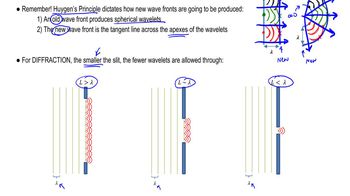
Every point on a wavefront acts as a source of spherical wavelets, which spread out in all directions.
How is the new wavefront formed according to Huygens' principle?
The new wavefront is the tangent line that crosses the apexes of all the spherical wavelets produced by the old wavefront.
What happens to light when it passes through a slit much larger than its wavelength?
Light remains collimated and shows no noticeable diffraction when the slit is much larger than the wavelength.
How does the wavefront change when the slit size is near the wavelength of light?
The wavefront curves slightly at the edges, causing partial diffraction, while the center remains mostly collimated.
What is observed when the slit size is much smaller than the wavelength?
Only a single wavelet can pass through, resulting in spherical wavefronts and isotropic light spread, indicating significant diffraction.
Why can you never make a slit so small that only a single wavelet is produced?
Because wavelets occur everywhere on the old wavefront, there will always be multiple wavelets passing through a slit, no matter how small.
What causes light to emerge at various angles from a slit?
Multiple wavelets passing through the slit cause light to emerge at different angles, leading to interference patterns.
What is the result of light passing through two slits in a double slit experiment?
Light from each slit interferes constructively or destructively depending on the path differences, creating a diffraction pattern with varying brightness.
How does the distance between the slits and the screen affect the interference pattern?
A larger distance between the slits and the screen allows for clearer and more distinct diffraction patterns.
What happens to the light rays at the edges of a slit when the slit size is near the wavelength?
The light rays at the edges spread out due to diffraction, while those at the center remain collimated.
What is the relationship between slit width and the number of wavelets passing through?
As the slit width decreases, the number of wavelets passing through also decreases, increasing the degree of diffraction.
What type of interference occurs when light from different parts of a slit interacts?
Destructive interference occurs when light waves from different parts of the slit interact and cancel each other out.
What is a diffraction pattern and how is it formed?
A diffraction pattern is a series of bright and dark spots formed by constructive and destructive interference of light passing through slits.
How do light rays behave after passing through a very small slit?
Light rays spread out isotropically, meaning they radiate in all directions, due to significant diffraction.
What is the main difference between the diffraction pattern from a single slit and a double slit?
The main difference is the width of the central bright spot, which is wider in a single slit pattern compared to a double slit pattern.
 Back
Back


 14:47
14:47