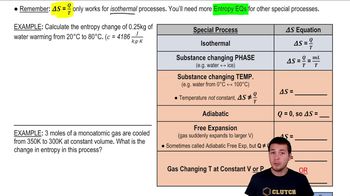
What is the equation for entropy change in an isothermal process?
Delta S = Q/T, where Q is the heat transferred and T is the constant temperature.
When can you use Delta S = Q/T to calculate entropy change?
You can use it for isothermal processes or phase changes where temperature remains constant.
What equation is used for entropy change when a substance changes temperature but not phase?
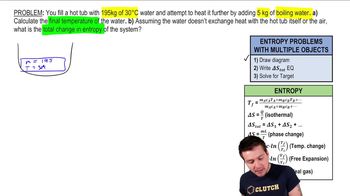
Delta S = m*c*ln(T_final/T_initial), where m is mass, c is specific heat, and T_final and T_initial are final and initial temperatures in Kelvin.
Why can't you use Delta S = Q/T for processes where temperature changes?
Because the temperature is not constant, so Q/T does not accurately represent the entropy change.
What is the entropy change for an adiabatic process?
Delta S = 0, because there is no heat transfer (Q = 0) in an adiabatic process.
How is entropy change calculated for a free expansion process?
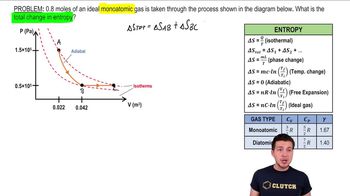
Delta S = n*R*ln(V_final/V_initial), where n is moles, R is the gas constant, and V_final and V_initial are final and initial volumes.
What distinguishes free expansion from adiabatic processes?
In free expansion, Q is not zero and entropy increases, while in adiabatic processes Q = 0 and entropy does not change.
What equation is used for entropy change in an isochoric (constant volume) process?
Delta S = n*Cv*ln(T_final/T_initial), where Cv is the heat capacity at constant volume.
What equation is used for entropy change in an isobaric (constant pressure) process?
Delta S = n*Cp*ln(T_final/T_initial), where Cp is the heat capacity at constant pressure.
What is the significance of the natural logarithm in entropy equations for special processes?
The natural logarithm (ln) is used to relate the ratio of final to initial states, such as temperature or volume, in entropy calculations.
How do you convert Celsius temperatures to Kelvin for entropy calculations?
Add 273 to the Celsius temperature to get the value in Kelvin.
What happens to entropy when heat is added to a substance and its temperature increases?
Entropy increases, as energy is spread out more and the system becomes more disordered.
What happens to entropy when a monoatomic gas is cooled at constant volume?
Entropy decreases, since heat is removed and the system becomes less disordered.
How do you determine which entropy equation to use for a given process?
Identify the type of process (isothermal, adiabatic, free expansion, isochoric, isobaric) and use the corresponding equation based on whether temperature or volume changes and what information is given.
What is the value of Cv for a monoatomic gas used in entropy calculations?
Cv = (3/2)R, where R is the universal gas constant (8.314 J/mol·K).