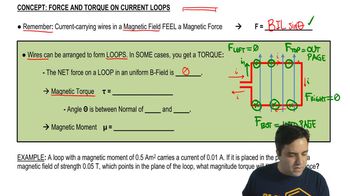
What is the net force on a current-carrying loop placed in a uniform magnetic field?
The net force on the loop is always zero because the forces on opposite sides of the loop cancel each other out.
Why does a current loop in a magnetic field experience a torque even though the net force is zero?
The forces on different segments of the loop create a couple that causes rotation, resulting in a torque.
How do you determine the direction of the magnetic force on a segment of a current-carrying wire?
You use the right-hand rule: point your thumb in the direction of current and your fingers in the direction of the magnetic field; your palm points in the direction of the force.
What happens to the magnetic force on a wire segment when the current is parallel to the magnetic field?
The magnetic force is zero when the current is parallel to the magnetic field.
What is the equation for the torque on a current loop in a magnetic field?
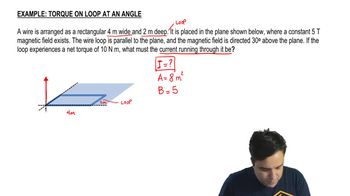
The torque is given by Torque = N * B * A * I * sin(theta), where N is the number of loops, B is the magnetic field strength, A is the area, I is the current, and theta is the angle between the normal to the loop and the magnetic field.
What does the variable 'N' represent in the torque equation for a current loop?
N represents the number of loops or turns in the wire coil.
How is the 'normal' to the area of a loop defined?
The normal is a line perpendicular (90 degrees) to the surface of the loop.
In the torque equation, what is the angle theta measured between?
Theta is the angle between the normal to the loop's area and the direction of the magnetic field.
What is the equation for the magnetic moment of a current loop?
The magnetic moment, mu, is given by mu = N * A * I.
How can the torque equation be rewritten using the magnetic moment?
The torque can be written as Torque = mu * B * sin(theta), where mu is the magnetic moment.
If a problem does not specify the number of loops in a current loop, what value should you use for N?
You should use N = 1 unless otherwise stated.
What is the unit for torque in the SI system?
The unit for torque is newton-meter (N·m).
If the magnetic field is in the plane of the loop, what is the angle between the field and the normal to the loop?
The angle is 90 degrees because the normal is perpendicular to the plane.
What is the value of sin(90°), and why is it important in torque calculations?
Sin(90°) equals 1, which means the torque is maximized when the field and the normal are perpendicular.
Why might you use the magnetic moment in torque calculations instead of the full NBAI formula?
If the magnetic moment is given or easier to calculate, you can use it directly in the torque equation for simplicity.
 Back
Back
 05:03
05:03