Back

Force & Potential Energy quiz

Control buttons has been changed to "navigation" mode.
1/15
  • What does the Y-axis represent on a potential energy graph?

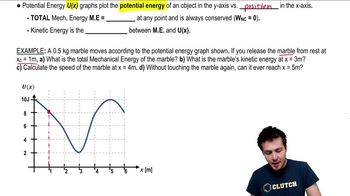
    The Y-axis represents the potential energy (U) of an object.
  • How do you determine the total mechanical energy at a point using a potential energy graph?

    Add the kinetic energy and the potential energy at that point; if the object is at rest, the total mechanical energy equals the potential energy.
  • If an object is released from rest at a point on a potential energy graph, what is its initial kinetic energy?

    Its initial kinetic energy is zero because its speed is zero.
  • How can you find the kinetic energy at a specific position using a potential energy graph?

    Subtract the potential energy at that position from the total mechanical energy: K = E_mech - U.
  • What does it mean if the potential energy at a point is equal to the total mechanical energy?

    It means the kinetic energy at that point is zero, so the object is momentarily at rest.
  • What are turning points in the context of a potential energy graph?

    Turning points are positions where the object's speed is zero and it reverses direction, corresponding to where the total mechanical energy equals the potential energy.
  • Can an object reach a position where the potential energy is greater than its total mechanical energy without external input?

    No, the object cannot reach such a position unless additional energy is added to the system.
  • What does the slope of a potential energy graph indicate about the force acting on an object?

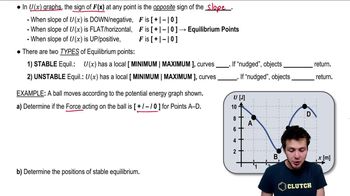
    The force has the opposite sign of the slope: a negative slope means positive force, and a positive slope means negative force.
  • What does a zero slope on a potential energy graph signify about the force?

    A zero slope means the force acting on the object is zero at that position.
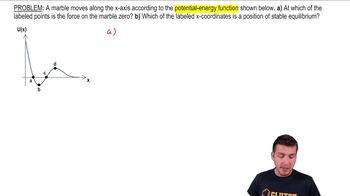
  • How do you identify stable equilibrium points on a potential energy graph?

    Stable equilibrium points are at the minimum of the potential energy curve, where the graph curves upward.
  • How do you identify unstable equilibrium points on a potential energy graph?

    Unstable equilibrium points are at the maximum of the potential energy curve, where the graph curves downward.
  • What happens to an object at a stable equilibrium if it is slightly displaced?

    It will return to the equilibrium position because the force acts to restore it.
  • What happens to an object at an unstable equilibrium if it is slightly displaced?

    It will move further away from the equilibrium position because the force pushes it away.
  • Why is the total mechanical energy constant in these potential energy graph problems?

    Because the work done by non-conservative forces is zero, so energy is conserved.
  • What analogy is used to describe stable and unstable equilibrium points?

    A marble in a bowl represents stable equilibrium (returns to center), while a marble on an inverted bowl represents unstable equilibrium (rolls away if nudged).