Skip to main content
Physics with Calculus
My Course
Learn
Exam Prep
AI Tutor
Study Guides
Textbook Solutions
Flashcards
Explore
Try the app
My Course
Learn
Exam Prep
AI Tutor
Study Guides
Textbook Solutions
Flashcards
Explore
Try the app
Back
How Dielectrics Work quiz
You can tap to flip the card.
What is a dielectric?
You can tap to flip the card.
👆
What is a dielectric?
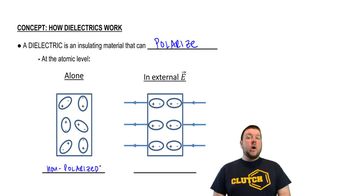
A dielectric is an insulating material that can polarize by aligning its charges in response to an external electric field.
Track progress
Control buttons has been changed to "navigation" mode.
1/15
Related flashcards
Related practice
Recommended videos
How Dielectrics Work definitions
How Dielectrics Work
10 Terms
How Dielectrics Work
26. Capacitors & Dielectrics
5 problems
Topic
Dielectric Breakdown
26. Capacitors & Dielectrics
1 problem
Topic
David-Paige
26. Capacitors & Dielectrics - Part 1 of 2
4 topics
7 problems
Chapter
David-Paige
26. Capacitors & Dielectrics - Part 2 of 2
5 topics
11 problems
Chapter
Patrick
Guided course
02:42
How Dielectrics Work
6510
views
98
rank
2
comments
Terms in this set (15)
Hide definitions
What is a dielectric?
A dielectric is an insulating material that can polarize by aligning its charges in response to an external electric field.
What happens to the charges in a dielectric when there is no external electric field?
The charges within the dielectric are randomly oriented, resulting in a non-polarized state.
How do charges in a dielectric respond to an external electric field?
Negative charges move up the electric field, and positive charges move down, aligning themselves according to the field direction.
What does it mean for a dielectric to be polarized?
A polarized dielectric has its charges aligned in a specific way due to the presence of an external electric field.
How does a dielectric affect the electric field inside a capacitor?
A dielectric reduces the electric field inside the capacitor compared to when the capacitor is in a vacuum.
What is the state of an insulator's charges when left alone without an electric field?
The charges are oriented in random directions, making the insulator non-polarized.
What is the main property that distinguishes a dielectric from other insulators?
A dielectric can polarize in response to an external electric field, while other insulators may not.
How do dielectrics impact the number of electric field lines in a capacitor?
Dielectrics absorb some electric field lines, reducing the number that pass through compared to a vacuum.
What happens to the electric field lines inside a dielectric compared to a vacuum?
The number of electric field lines inside a dielectric is reduced compared to a vacuum.
Why do dielectrics reduce the electric field within them?
Because their charges align and absorb some of the field lines, decreasing the field's intensity inside the material.
What is the effect of inserting a dielectric partially into a capacitor?
The electric field inside the region with the dielectric is reduced compared to the region with only vacuum.
How do positive and negative charges in a dielectric move in an electric field?
Negative charges move up the electric field, while positive charges move down the electric field.
What is the orientation of charges in a non-polarized dielectric?
The charges are oriented randomly with no preferred direction.
What is the result of polarization in a dielectric at the atomic level?
The atoms or molecules align their charges with the direction of the external electric field.
How does the presence of a dielectric alter the field distribution in a capacitor?
The dielectric changes the distribution and intensity of the electric field by reducing the field within its region.
 BackBack

 02:42
02:42