What is the main purpose of Lorentz transformations in special relativity?
Lorentz transformations relate measurements between different inertial frames, accounting for time dilation and length contraction at high speeds.
Why do Galilean transformations fail at speeds close to the speed of light?
Galilean transformations ignore relativistic effects like time dilation and length contraction, which become significant as speeds approach the speed of light.
What is the Lorentz factor (gamma) and how is it calculated?
Gamma is 1 divided by the square root of 1 minus u squared over c squared, where u is the relative velocity and c is the speed of light.
Along which axis does length contraction occur in Lorentz transformations?
Length contraction only occurs along the direction of the boost, typically the x-axis.
How do positions in the y and z directions transform under Lorentz transformations when the boost is along the x-axis?
Positions in the y and z directions remain unchanged because there is no relative velocity or length contraction in those directions.
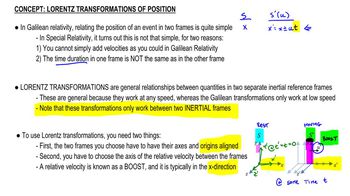
What is the equation for x' in Lorentz transformations?
x' = gamma times (x minus u times t), where x and t are measured in the rest frame.
What is the equation for t' in Lorentz transformations?
t' = gamma times (t minus u times x divided by c squared), where t and x are measured in the rest frame.
Why is time dilation important in Lorentz transformations?
Time dilation ensures that time intervals measured in different inertial frames are not equal, affecting how events are related between frames.
What happens to the Lorentz factor (gamma) when the relative velocity is much less than the speed of light?
Gamma approaches 1, so relativistic effects like time dilation and length contraction become negligible.
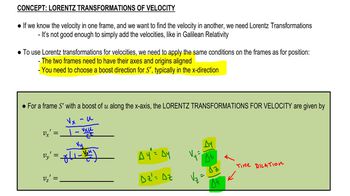
How do you transform the x-component of velocity between frames using Lorentz transformations?
The x-component in the moving frame is (vx - u) divided by (1 - vx times u over c squared).
Why do velocities in the y and z directions change under Lorentz transformations even though their positions do not?
Velocities change due to time dilation, as the time interval measured in different frames affects the velocity calculation.
What is the equation for transforming the y-component of velocity between frames?
vy' = vy divided by gamma times (1 - vx times u over c squared), where gamma is the Lorentz factor.
Why can't you simply add velocities in special relativity as you do in Galilean relativity?
Simple addition can result in speeds exceeding the speed of light, which violates special relativity; Lorentz transformations prevent this.
What happens to the measured velocity of an object moving perpendicular to the boost direction?
The measured velocity is reduced due to time dilation, even though the distance remains the same.
What is the significance of aligning the origins of two inertial frames at t = 0 in Lorentz transformations?
Aligning origins ensures consistent initial conditions for applying Lorentz transformation equations between the frames.
 Back
Back

 14:16
14:16