Skip to main content
Physics with Calculus
My Course
Learn
Exam Prep
AI Tutor
Study Guides
Textbook Solutions
Flashcards
Explore
Try the app
My Course
Learn
Exam Prep
AI Tutor
Study Guides
Textbook Solutions
Flashcards
Explore
Try the app
Back
Work As Area Under F-x Graphs quiz
You can tap to flip the card.
What does the area under a force versus displacement (F-x) graph represent?
You can tap to flip the card.
👆
What does the area under a force versus displacement (F-x) graph represent?
The area under an F-x graph represents the work done by the force on the object.
Track progress
Control buttons has been changed to "navigation" mode.
1/15
Related flashcards
Related practice
Recommended videos
Work As Area Under F-x Graphs definitions
Work As Area Under F-x Graphs
15 Terms
Work As Area Under F-x Graphs
9. Work & Energy
1 problem
Topic
David-Paige
Calculating Work by Integration (Calculus)
9. Work & Energy
5 problems
Topic
9. Work & Energy - Part 1 of 2
3 topics
8 problems
Chapter
Patrick
9. Work & Energy - Part 2 of 2
5 topics
12 problems
Chapter
David-Paige
Guided course
04:05
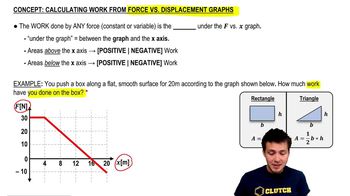
Calculating Work As Area Under F-x Graphs
9604
views
123
rank
Guided course
03:53
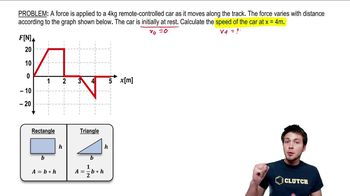
Speed of a Remote Controlled Car Using F-x Graph
7601
views
128
rank
4
comments
Terms in this set (15)
Hide definitions
What does the area under a force versus displacement (F-x) graph represent?
The area under an F-x graph represents the work done by the force on the object.
How do you calculate the area of a rectangle on a force-displacement graph?
You calculate the area of a rectangle by multiplying its base by its height.
What formula is used to find the area of a triangle on a force-displacement graph?
The area of a triangle is found using the formula one-half base times height.
How do you determine the total work done from a force-displacement graph with multiple shapes?
Add the areas of all the shapes (rectangles and triangles), considering their signs, to get the total work done.
What does a positive area above the x-axis on an F-x graph indicate?
A positive area above the x-axis indicates positive work, meaning the force is in the direction of displacement.
What does a negative area below the x-axis on an F-x graph represent?
A negative area below the x-axis represents negative work, where the force acts opposite to the displacement.
If a rectangle on an F-x graph has a base of 4 and a height of 30, what is its area?
The area is 4 times 30, which equals 120 joules.
How do you calculate the area of a triangle with a base of 12 and a height of 30 on an F-x graph?
The area is one-half times 12 times 30, which equals 180 joules.
If a triangle below the x-axis has a base of 4 and a height of -10, what is its area?
The area is one-half times 4 times -10, which equals -20 joules.
How do you find the net work done when there are both positive and negative areas on the F-x graph?
Sum all the positive and negative areas to find the net work done.
Why might using an F-x graph be easier than using the formula W = Fd cosθ for variable forces?
Because you can visually break the graph into simple shapes and sum their areas, avoiding complex calculations with average forces.
What is the total work done if the areas under the F-x graph are 120 J, 180 J, and -20 J?
The total work done is 120 + 180 + (-20) = 280 joules.
What should you do if the force on the F-x graph changes direction (crosses the x-axis)?
Calculate the area for each section separately, assigning positive or negative signs based on their position relative to the x-axis.
What does the phrase 'area under the graph' mean in the context of work and F-x graphs?
It means the area between the force-displacement curve and the x-axis.
What is the main advantage of using the area under an F-x graph to calculate work for variable forces?
It simplifies the calculation by allowing you to use basic geometry instead of more complex formulas involving average forces.
 BackBack

 04:05
04:05