Back

Mutual Inductance quiz

Control buttons has been changed to "navigation" mode.
1/15
  • What is mutual inductance in the context of two coils?

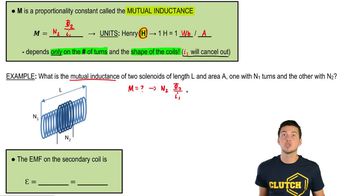
    Mutual inductance is a property that describes how a changing current in one coil (the primary) induces an EMF in another coil (the secondary).
  • What is the formula for the induced EMF in the secondary coil due to mutual inductance?

    The induced EMF is given by EMF = -M * (ΔI/Δt), where M is the mutual inductance.
  • What are the units of mutual inductance?

    Mutual inductance is measured in Henrys (H).
  • On what physical properties does mutual inductance depend?

    Mutual inductance depends on the number of turns and the shape of the coils, not on the current.
  • How is the total magnetic flux in the secondary coil related to the current in the primary coil?

    The total magnetic flux in the secondary coil is proportional to the current in the primary coil.
  • What is the mathematical expression for mutual inductance using flux and current?

    Mutual inductance M = N2 * Φ2 / I1, where N2 is the number of turns in the secondary coil, Φ2 is the flux through the secondary, and I1 is the current in the primary.
  • How does the direction of the magnetic field affect the calculation of mutual inductance?

    The direction of the magnetic field does not affect the calculation of mutual inductance; only the magnitude and coil properties matter.
  • What is the formula for the mutual inductance between two solenoids?

    M = (μ₀ * N1 * N2 * A2) / L, where μ₀ is the permeability of free space, N1 and N2 are the number of turns, A2 is the area of the secondary, and L is the length of the primary.
  • Why does the current cancel out in the mutual inductance formula?

    The current cancels out because the magnetic field produced by the primary coil is proportional to the current, so it appears in both the numerator and denominator.
  • What does the negative sign in the induced EMF formula represent?

    The negative sign represents Lenz's law, indicating that the induced EMF opposes the change in current.
  • How can Faraday's law be rewritten in terms of mutual inductance?

    Faraday's law for induced EMF can be rewritten as EMF = -M * (ΔI/Δt) for mutual inductance.
  • If the current in the primary coil changes rapidly, what happens to the induced EMF in the secondary coil?

    A rapid change in current in the primary coil results in a larger induced EMF in the secondary coil.
  • What is the role of the number of turns in the secondary coil in mutual inductance?

    The number of turns in the secondary coil increases the total induced EMF, as it is directly proportional to mutual inductance.
  • In the example with two solenoids, what information is needed to calculate the induced EMF?

    You need the mutual inductance value and the rate of change of current (ΔI/Δt) in the primary coil.
  • What is the physical significance of mutual inductance in electrical circuits?

    Mutual inductance quantifies how effectively a changing current in one coil can induce a voltage in another coil, which is fundamental in transformers and coupled circuits.