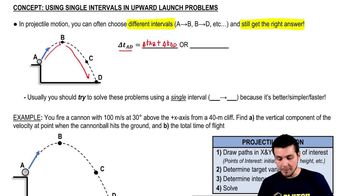
What distinguishes a non-symmetrical upward launch from a symmetrical one?
In a non-symmetrical upward launch, the object is launched from and lands at different heights, unlike a symmetrical launch where it returns to the same height.
Why is it beneficial to include the maximum height in calculations for upward launches from a higher point?
At maximum height, the vertical velocity is zero, which simplifies the kinematic equations used in calculations.
What is the value of acceleration due to gravity used in these projectile motion problems?
The acceleration due to gravity is always -9.8 m/s².
When solving for the vertical velocity just before hitting the ground, why might you choose the interval from maximum height to the final point?
Because the initial vertical velocity at maximum height is zero, making the equations simpler to solve.
What are the key variables needed to solve projectile motion problems?
Key variables include acceleration due to gravity, initial and final velocities, and vertical displacement.
How can symmetry in projectile motion help in solving problems?
Symmetry allows you to predict velocities at different points if the initial conditions are known, especially for intervals that mirror each other.
What is usually the simplest interval to use when solving for total time or final velocities in non-symmetrical launches?
Using a single interval from the start point (A) to the final point (D) is usually the simplest.
If a projectile is launched from a 20 m high cliff and reaches a maximum height of 49.4 m above the ground, what is the vertical displacement from the peak to the ground?
The vertical displacement from the peak to the ground is -49.4 m (negative because it is downward).
When calculating the final vertical velocity before impact, why do you choose the negative root of the equation?
Because the negative value indicates the velocity is directed downward, which matches the physical situation just before impact.
How do you find the vertical component of the initial velocity if you know the launch speed and angle?
Multiply the launch speed by the sine of the launch angle.
What is the vertical displacement from the top of a 40 m cliff to the ground?
The vertical displacement is -40 m, since the object moves downward from the cliff to the ground.
Why is it often easier to use a single interval from launch to landing when solving projectile problems?
It reduces complexity by focusing only on the initial and final conditions, ignoring intermediate points.
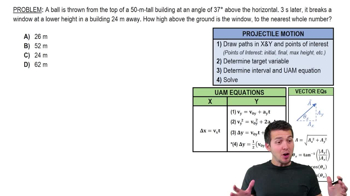
What equation can you use to solve for the final vertical velocity when time is unknown?
Use the equation: final velocity squared equals initial velocity squared plus 2 times acceleration times displacement.
How do you determine the total time of flight for a projectile launched from a height?
List all known variables, use the kinematic equations, and solve for time using the interval from launch to landing.
What should you do if you get stuck using one interval in a projectile motion problem?
Try using a different interval or break the motion into smaller segments to find the necessary variables.
 Back
Back
 05:41
05:41