What is self-inductance in a current-carrying wire?
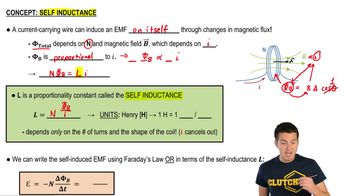
Self-inductance is the ability of a wire to induce an EMF on itself by changing its magnetic flux.
How is the magnetic flux through a coil related to the current?
The magnetic flux is proportional to the current, with the proportionality constant being the self-inductance (L).
What is the formula for self-inductance (L)?
L = n(ΦB/I), where n is the number of turns, ΦB is the magnetic flux, and I is the current.
What are the units of self-inductance?
The unit of self-inductance is the Henry (H), which is equivalent to Weber per Ampere.
On what factors does self-inductance depend?
Self-inductance depends only on the number of turns (n) and the shape of the coil.
Is self-inductance a physical property of the coil or does it depend on the current?
Self-inductance is a physical property of the coil and is independent of the current.
How can Faraday’s law be used to relate self-induced EMF to the coil?
Faraday’s law relates EMF to the number of turns and the rate of change of magnetic flux, but for self-inductance, EMF can also be written as -L(ΔI/ΔT).
What is the expression for self-induced EMF using self-inductance?
The self-induced EMF is given by -L(ΔI/ΔT), where ΔI/ΔT is the rate of change of current.
What happens to the current in the formula for self-inductance when calculating for a single loop?
The current cancels out, showing that L is independent of the current and depends only on coil properties.
What is the formula for the magnetic field at the center of a single loop of wire?
The magnetic field is μ₀I/(2r), where μ₀ is the permeability of free space, I is the current, and r is the radius.
How do you calculate the area vector for a loop of wire?
The area vector is perpendicular to the surface of the loop and points in the same direction as the magnetic field.
What is the formula for the magnetic flux through a single loop?
The magnetic flux is B × A, where B is the magnetic field and A is the area of the loop.
How do you find the self-inductance for a single loop of wire?
For a single loop, L = μ₀πr/2, where r is the radius of the loop and μ₀ is the permeability of free space.
Why does the cosine theta term become 1 in the calculation of flux for a loop?
Because the magnetic field and area vector point in the same direction, making θ = 0 and cos(0) = 1.
What does the self-inductance of a coil represent?
It represents the coil’s ability to induce an EMF in itself when the current changes, and is determined by its physical characteristics.