Physics
My Course
Learn
Exam Prep
AI Tutor
Study Guides
Textbook Solutions
Flashcards
Explore
My Course
Learn
Exam Prep
AI Tutor
Study Guides
Textbook Solutions
Flashcards
Explore
Back
Solving Projectile Motion Using Energy quiz
You can tap to flip the card.
Define:
What is the main advantage of using energy conservation to solve projectile motion problems?
You can tap to flip the card.
👆
What is the main advantage of using energy conservation to solve projectile motion problems?
Energy conservation allows for quicker and more straightforward calculations of speeds and heights compared to traditional motion equations.
Track progress
Control buttons has been changed to "navigation" mode.
1/15
Related flashcards
Related practice
Recommended videos
Solving Projectile Motion Using Energy definitions
Solving Projectile Motion Using Energy
15 Terms
10. Conservation of Energy
7 topics
15 problems
Chapter
Patrick
Guided course
04:27
Projectile Motion with Energy
Patrick
7948
views
97
rank
2
comments
Guided course
05:01
Calculating Max Height with Energy Conservation
Patrick
7071
views
109
rank
5
comments
Terms in this set (15)
Hide definitions
What is the main advantage of using energy conservation to solve projectile motion problems?
Energy conservation allows for quicker and more straightforward calculations of speeds and heights compared to traditional motion equations.
What is the energy conservation equation used in projectile motion problems?
The equation is 1/2mv_a^2 + mgh_a = 1/2mv_d^2, where v_a is initial speed, h_a is initial height, and v_d is final speed.
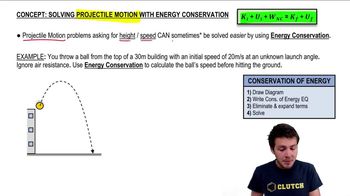
In the example, what is the initial height from which the ball is thrown?
The ball is thrown from a height of 30 meters above the ground.
What is the initial speed of the ball in the example problem?
The initial speed of the ball is 28 meters per second.
What happens to the mass variable in the energy conservation equation when solving for speed?
The mass cancels out from both sides of the equation since it appears in every term.
What is the gravitational potential energy at the ground level?
At ground level, gravitational potential energy is zero because the height is zero.
Why is the work done by non-conservative forces ignored in this example?
It is ignored because air resistance is neglected and the problem starts after the ball leaves the hand, so no work is done by you.
What is the final speed of the ball just before it hits the ground according to the energy conservation calculation?
The final speed is approximately 31.4 meters per second.
How does energy conservation simplify solving projectile motion problems with unknown launch angles?
It eliminates the need to use complex motion equations and systems, making the calculation more straightforward.
What are the main forms of energy considered in the energy conservation equation for projectile motion?
The main forms are kinetic energy and gravitational potential energy.
At which point in the projectile's path is the gravitational potential energy highest?
It is highest at the initial point where the ball is at the top of the building.
What is the kinetic energy formula used in the energy conservation equation?
Kinetic energy is given by 1/2mv^2, where m is mass and v is velocity.
What is the gravitational potential energy formula used in the energy conservation equation?
Gravitational potential energy is mgh, where m is mass, g is gravity, and h is height.
Why is the energy conservation method considered more powerful for certain projectile motion problems?
Because it can solve problems more quickly and handle cases where traditional equations are cumbersome, such as unknown angles.
What is the value of g (acceleration due to gravity) used in the example calculation?
The value of g used is 9.8 meters per second squared.