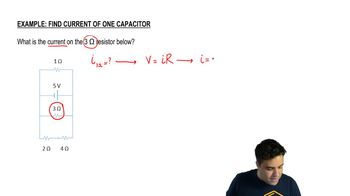
What is the equation for finding equivalent resistance for resistors in series?
The equivalent resistance in series is the sum of the individual resistances: Req = R1 + R2 + ... + Rn.
What is the equation for finding equivalent resistance for resistors in parallel?
The reciprocal of the equivalent resistance is the sum of the reciprocals of the individual resistances: 1/Req = 1/R1 + 1/R2 + ... + 1/Rn.
In a series circuit, what property is shared by all resistors and the equivalent resistor?
All resistors in series share the same current, which is also the current through the equivalent resistor.
In a parallel circuit, what property is shared by all resistors and the equivalent resistor?
All resistors in parallel share the same voltage, which is also the voltage across the equivalent resistor.
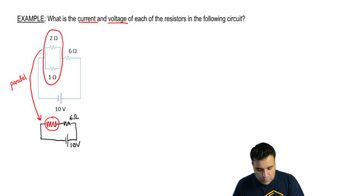
What is the three-step method for solving complex resistor circuits?
First, reduce the circuit to one equivalent resistor; second, use Ohm's Law to find voltage and current; third, work backwards to find voltage and current for each original resistor.
How do you use Ohm's Law to find current if you know voltage and resistance?
Current is found by dividing voltage by resistance: I = V/R.
When combining resistors in series, what happens to the current through each resistor?
The current remains the same through each resistor and the equivalent resistor.
When combining resistors in parallel, what happens to the voltage across each resistor?
The voltage remains the same across each resistor and the equivalent resistor.
If two resistors of 2 Ω and 1 Ω are in parallel, what is their equivalent resistance?
Their equivalent resistance is (2*1)/(2+1) = 2/3 ≈ 0.67 Ω.
After reducing a circuit to one equivalent resistor, what does the voltage across it equal?
The voltage across the equivalent resistor equals the voltage of the battery.
How do you find the voltage across a resistor if you know its resistance and the current through it?
Use Ohm's Law: V = IR.
If a 6 Ω resistor has a current of 1.5 A, what is the voltage across it?
The voltage is V = 1.5 A × 6 Ω = 9 V.
How do you determine the current through a resistor in parallel if you know the voltage and resistance?
Divide the voltage by the resistance: I = V/R.
What does Kirchhoff's junction rule state about currents at a node?
The total current entering a node equals the total current leaving the node.
Why is it important to be systematic and organized when solving resistor circuit problems?
Being systematic and organized helps avoid confusion and ensures all values for voltage, current, and resistance are correctly found for each resistor.
 Back
Back
 17:24
17:24