Skip to main content
Physics with Calculus
My Course
Learn
Exam Prep
AI Tutor
Study Guides
Textbook Solutions
Flashcards
Explore
Try the app
My Course
Learn
Exam Prep
AI Tutor
Study Guides
Textbook Solutions
Flashcards
Explore
Try the app
Back
Spring Force (Hooke's Law) quiz
1 student found this helpful
You can tap to flip the card.
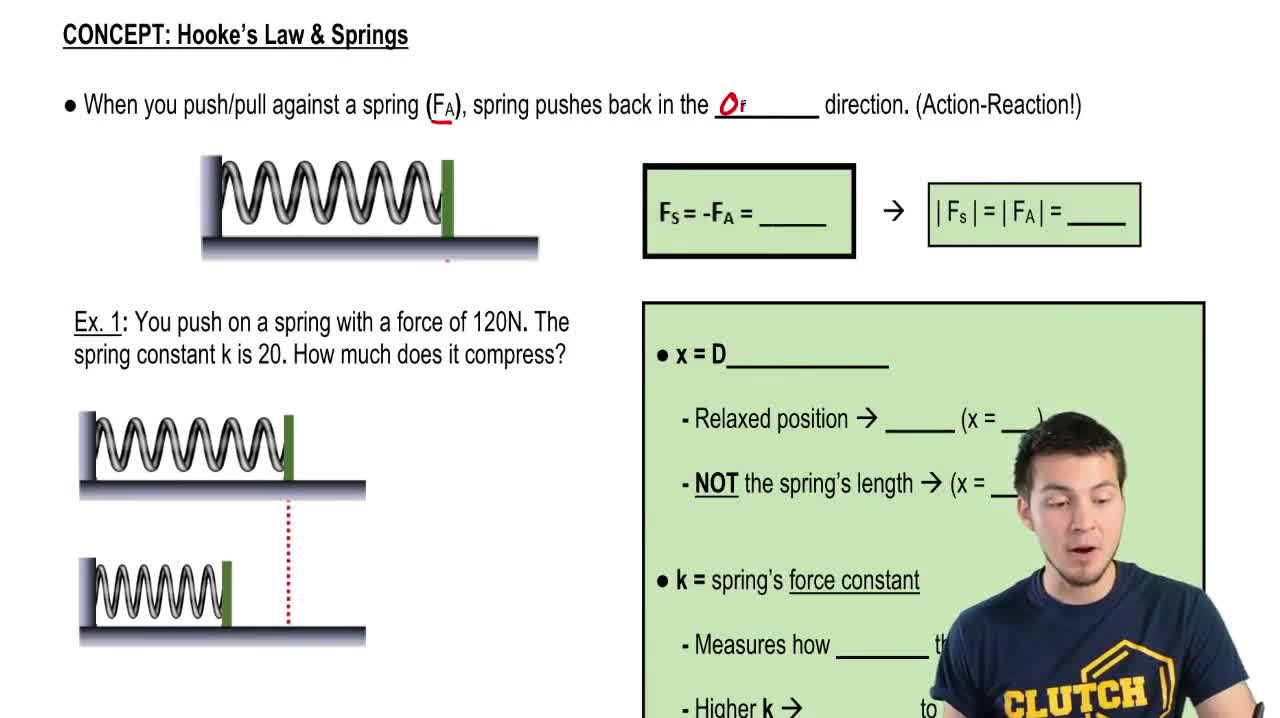
What does Hooke's Law state about the relationship between spring force and displacement?
You can tap to flip the card.
👆
What does Hooke's Law state about the relationship between spring force and displacement?
Hooke's Law states that the force exerted by a spring is proportional to its displacement from equilibrium, given by F = -kx.
Track progress
Control buttons has been changed to "navigation" mode.
1/15
Related flashcards
Related practice
Recommended videos
Spring Force (Hooke's Law) definitions
Spring Force (Hooke's Law)
15 Terms
Spring Force (Hooke's Law)
17. Periodic Motion
7 problems
Topic
Patrick
Intro to Simple Harmonic Motion (Horizontal Springs)
17. Periodic Motion
7 problems
Topic
Patrick
17. Periodic Motion - Part 1 of 2
4 topics
10 problems
Chapter
Patrick
17. Periodic Motion - Part 2 of 2
3 topics
9 problems
Chapter
David-Paige
Guided course
05:27
Spring Force (Hooke's Law)
27425
views
580
rank
13
comments
Guided course
03:37
Acceleration of Mass-Spring Systems
9906
views
193
rank
1
comments
Terms in this set (15)
Hide definitions
What does Hooke's Law state about the relationship between spring force and displacement?
Hooke's Law states that the force exerted by a spring is proportional to its displacement from equilibrium, given by F = -kx.
What does the negative sign in Hooke's Law indicate?
The negative sign shows that the spring force acts in the direction opposite to the displacement, aiming to restore equilibrium.
How is the spring constant (k) defined and what are its units?
The spring constant quantifies the stiffness of the spring and its units are newtons per meter (N/m).
What is the equilibrium position of a spring?
The equilibrium position is the relaxed state of the spring where x = 0 and no force is exerted.
How do you calculate the deformation (x) of a spring when stretched or compressed?
Deformation x is the difference between the final and initial length of the spring relative to its equilibrium position.
What is the formula for the magnitude of spring force when only the magnitude is needed?
The magnitude of the spring force is given by |F| = kx.
If a spring is compressed by 6 meters with a spring constant of 20 N/m, what is the spring force?
The spring force is 120 newtons, acting in the direction opposite to the compression.
How does doubling the spring constant affect the spring force for the same deformation?
Doubling the spring constant doubles the spring force for the same amount of deformation.
What is meant by the term 'restoring force' in the context of springs?
A restoring force is a force that acts to return the spring to its equilibrium position, opposing the deformation.
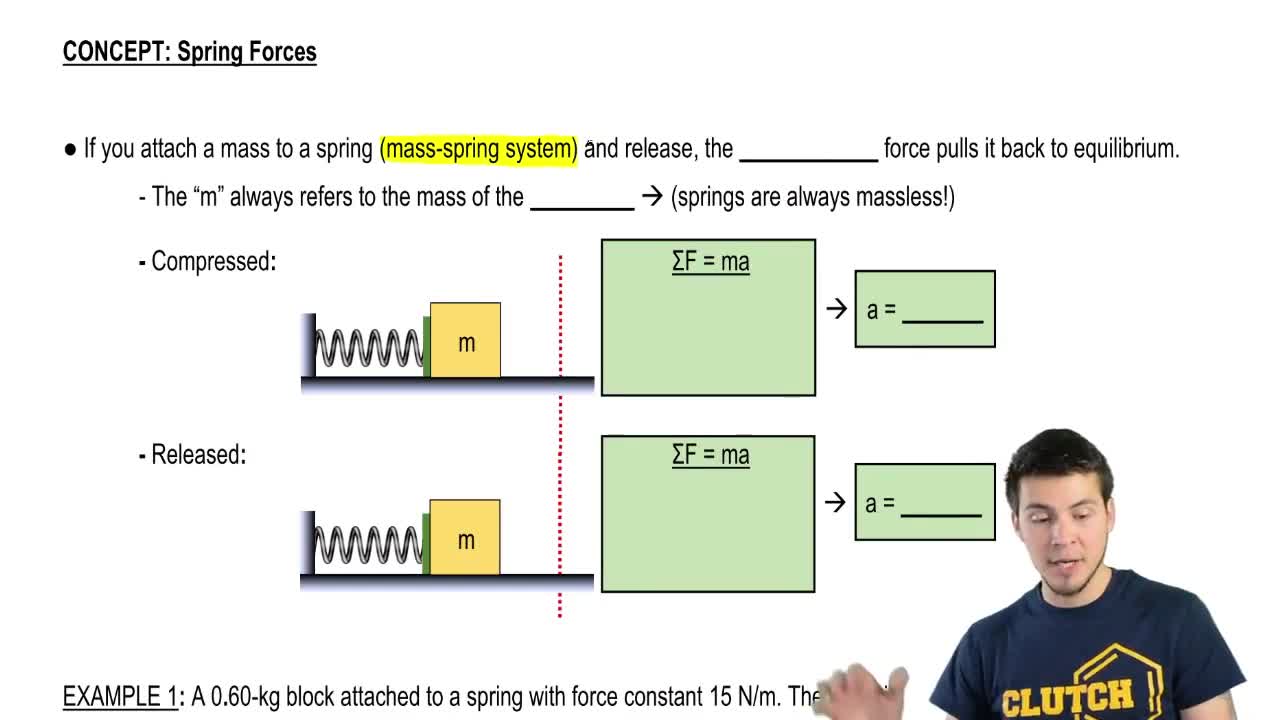
In a mass-spring system, what formula relates acceleration to spring force?
Acceleration is given by a = -(k/m)x, where k is the spring constant, m is the mass, and x is the displacement.
Why is the mass of the spring often assumed to be zero in calculations?
Assuming the spring's mass is zero simplifies calculations by focusing only on the mass attached to the spring.
What happens to the forces when a mass attached to a spring is held stationary?
The applied force and spring force are equal and opposite, resulting in zero acceleration (m a = 0).
What direction does the spring force act when a spring is stretched to the right?
The spring force acts to the left, opposite to the direction of stretching.
How do you calculate the spring force for a 0.60 kg block stretched 0.2 meters with a spring constant of 15 N/m?
The spring force is F = -15 × 0.2 = -3 newtons, indicating a force to the left.
What is the acceleration of a 0.60 kg block attached to a spring with k = 15 N/m and x = 0.2 m?
The acceleration is a = -(15/0.6) × 0.2 = -5 m/s², directed to the left.
 BackBack

 05:27
05:27