Back

Standing Sound Waves quiz

Control buttons has been changed to "navigation" mode.
1/15
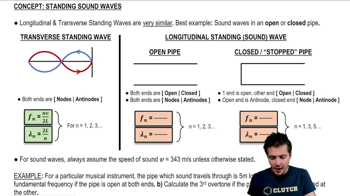
  • What type of wave are sound waves in pipes: longitudinal or transverse?

    Sound waves in pipes are longitudinal waves.
  • In an open pipe, what is present at both ends: nodes or antinodes?

    Both ends of an open pipe are antinodes.
  • In a closed pipe, what is present at the closed end and at the open end?

    The closed end is a node, and the open end is an antinode.
  • What is the equation for the frequency of the nth harmonic in an open pipe?

    The frequency is given by f_n = n*v/(2L), where n is any integer.
  • What is the equation for the wavelength of the nth harmonic in an open pipe?

    The wavelength is λ_n = 2L/n.
  • What is the equation for the frequency of the nth harmonic in a closed pipe?

    The frequency is f_n = n*v/(4L), where n is an odd integer.
  • What is the equation for the wavelength of the nth harmonic in a closed pipe?

    The wavelength is λ_n = 4L/n, with n being odd.
  • What values can n take for harmonics in an open pipe?

    n can be any positive integer: 1, 2, 3, and so on.
  • What values can n take for harmonics in a closed pipe?

    n can only be odd integers: 1, 3, 5, etc.
  • What is the standard speed of sound used in these calculations unless otherwise specified?

    The standard speed of sound is 343 m/s.
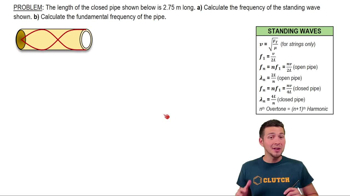
  • How do you calculate the fundamental frequency for an open pipe of length L?

    Use f_1 = v/(2L), where v is the speed of sound.
  • How do you calculate the fundamental frequency for a closed pipe of length L?

    Use f_1 = v/(4L), where v is the speed of sound.
  • For a closed pipe, what harmonic number corresponds to the third overtone?

    The third overtone corresponds to n = 7.
  • If a closed pipe is 5 meters long, what is the frequency of the third overtone using v = 343 m/s?

    The frequency is f_7 = 7*343/(4*5) = 120 Hz.
  • Why can't n = 2 be a harmonic in a closed pipe?

    Because only odd harmonics are allowed in closed pipes due to the boundary conditions.