Back

Standing Waves quiz

Control buttons has been changed to "navigation" mode.
1/15
  • What is a standing wave?

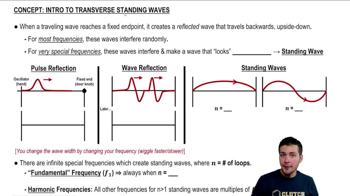
    A standing wave is a wave pattern formed by the interference of two waves traveling in opposite directions, creating a stationary appearance.
  • How is a standing wave created on a string tied to a fixed point?

    A standing wave is created when you whip the string, causing waves to reflect and invert at the fixed end, leading to interference.
  • What happens to a wave pulse when it reaches a fixed endpoint?

    The pulse is reflected and inverted, traveling back in the opposite direction.
  • What is the fundamental frequency in standing waves?

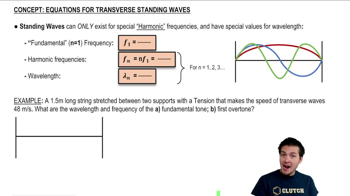
    The fundamental frequency is the lowest frequency at which a standing wave can form, corresponding to n=1.
  • How do you calculate the fundamental frequency of a string?

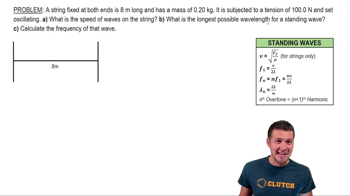
    The fundamental frequency is calculated using f1 = v / (2l), where v is wave speed and l is string length.
  • What is the formula for the wavelength of a standing wave?

    The wavelength is given by λ = 2l / n, where n is the number of loops.
  • How are harmonic frequencies related to the fundamental frequency?

    Harmonic frequencies are integer multiples of the fundamental frequency, expressed as fn = n * f1.
  • What does n represent in standing wave equations?

    n represents the number of loops or antinodes in the standing wave pattern.
  • What is the first overtone in terms of n?

    The first overtone corresponds to n=2, which is the second harmonic.
  • How do you find the frequency for a standing wave with 5 loops?

    Multiply the fundamental frequency by 5: f5 = 5 * f1.
  • Why can the wavelength of the fundamental frequency be longer than the string?

    Because the fundamental standing wave only shows half a wavelength on the string, so the full wavelength is twice the string length.
  • What is the relationship between speed, frequency, and wavelength?

    The relationship is v = λ * f, where v is speed, λ is wavelength, and f is frequency.
  • What is the wavelength for the first overtone on a 1.5 meter string?

    The wavelength is 1.5 meters, equal to the length of the string.
  • What is the frequency of the fundamental tone for a 1.5 meter string with wave speed 48 m/s?

    The fundamental frequency is 16 Hz, calculated as f1 = 48 / (2 * 1.5).
  • What is the frequency of the first overtone for the same string and speed?

    The frequency is 32 Hz, which is twice the fundamental frequency.