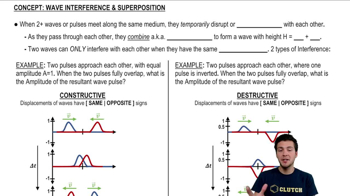
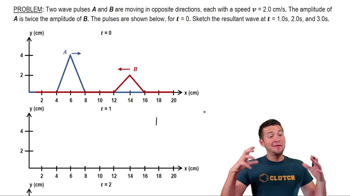
Wave interference is the interaction of two or more waves or pulses when they meet along the same medium.
What does the term 'superposition' mean in the context of waves?
Superposition refers to the combination of two or more overlapping waves, resulting in a new wave whose amplitude is the sum of the individual amplitudes.
What happens to waves after they interfere with each other?
After interfering, the waves continue to propagate independently as if the interaction never occurred.
What is constructive interference?
Constructive interference occurs when wave displacements are in the same direction, resulting in a combined amplitude equal to the sum of the individual amplitudes.
What is destructive interference?
Destructive interference happens when wave displacements are in opposite directions, causing the waves to partially cancel each other out and produce a reduced amplitude.
How do you calculate the amplitude of the resultant wave during constructive interference?
You add the amplitudes of the individual waves to get the amplitude of the resultant wave.
How do you calculate the amplitude of the resultant wave during destructive interference?
You add the amplitudes, taking into account their signs, which may result in partial cancellation and a reduced amplitude.
What is meant by 'superimpose' in wave interference?
To superimpose means to combine two or more waves so their amplitudes add together at each point.
What is required for two waves to interfere with each other?
The waves must have the same frequency to interfere with each other.
What happens when two wave pulses with positive amplitudes overlap?
They undergo constructive interference, resulting in a new wave with a larger amplitude.
What happens when one wave pulse is inverted and overlaps with another?
They undergo destructive interference, resulting in partial cancellation and a new wave with reduced amplitude.
What is the amplitude of the resultant wave if two pulses with amplitudes 1 and 1 overlap constructively?
The amplitude of the resultant wave is 2.
What is the amplitude of the resultant wave if two pulses with amplitudes 0.5 and -1 overlap destructively?
The amplitude of the resultant wave is -0.5.
Is the disruption caused by wave interference permanent?
No, the disruption is temporary; the waves continue as if nothing happened after they pass through each other.
What are the key terms associated with wave interference discussed in the lesson?
The key terms are interfere, superimpose, constructive interference, and destructive interference.