Skip to main content
Physics with Calculus
My Course
Learn
Exam Prep
AI Tutor
Study Guides
Textbook Solutions
Flashcards
Explore
Try the app
My Course
Learn
Exam Prep
AI Tutor
Study Guides
Textbook Solutions
Flashcards
Explore
Try the app
Back
Work By Springs quiz
You can tap to flip the card.
What equation describes the force exerted by a spring according to Hooke's Law?
You can tap to flip the card.
👆
What equation describes the force exerted by a spring according to Hooke's Law?
Hooke's Law is described by F = -kx, where k is the spring constant and x is the displacement from equilibrium.
Track progress
Control buttons has been changed to "navigation" mode.
1/15
Related flashcards
Related practice
Recommended videos
Work By Springs definitions
Work By Springs
15 Terms
Work By Springs
9. Work & Energy
8 problems
Topic
Patrick
Work As Area Under F-x Graphs
9. Work & Energy
1 problem
Topic
David-Paige
9. Work & Energy - Part 1 of 2
3 topics
8 problems
Chapter
Patrick
9. Work & Energy - Part 2 of 2
5 topics
12 problems
Chapter
David-Paige
Guided course
05:27
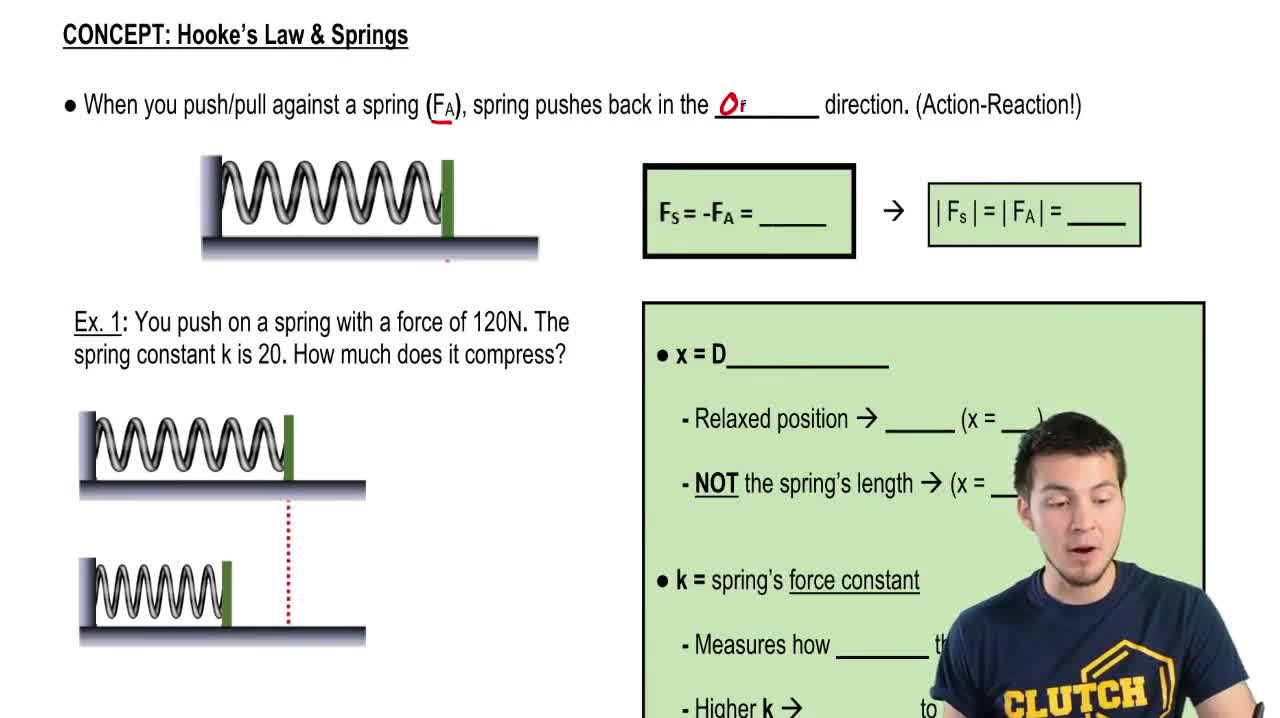
Spring Force (Hooke's Law)
27430
views
580
rank
13
comments
Guided course
04:45
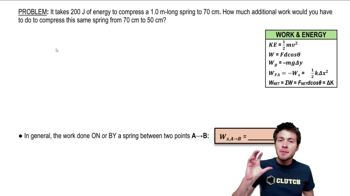
Additional Work to Compress Spring
10452
views
206
rank
9
comments
Guided course
05:58
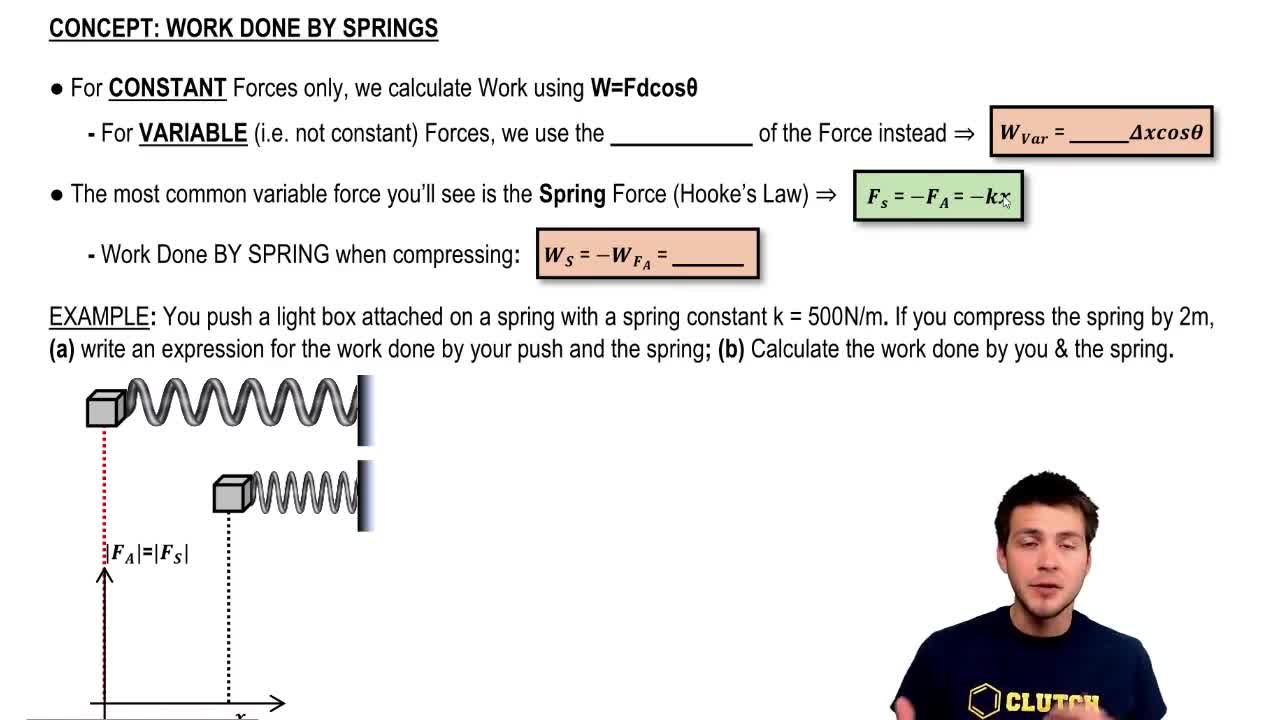
Work Done By Springs
13064
views
196
rank
4
comments
Terms in this set (15)
Hide definitions
What equation describes the force exerted by a spring according to Hooke's Law?
Hooke's Law is described by F = -kx, where k is the spring constant and x is the displacement from equilibrium.
What does the negative sign in Hooke's Law indicate about the direction of the spring force?
The negative sign means the spring force acts in the opposite direction to the displacement.
How are the spring force and applied force related in magnitude and direction?
They are equal in magnitude but opposite in direction, forming an action-reaction pair.
What is the spring constant 'k' and what are its units?
The spring constant 'k' measures the stiffness of the spring and is expressed in newtons per meter (N/m).
How do you calculate the deformation 'x' of a spring when given the force and spring constant?
Deformation x is calculated by rearranging Hooke's Law: x = F/k.
What is the equilibrium position of a spring?
The equilibrium position is where the spring is relaxed and x equals 0.
How do you determine the deformation when a spring is stretched from its original length?
Deformation x is the difference between the final and initial lengths of the spring.
What happens to the force required to deform a spring if the spring constant is doubled?
Doubling the spring constant doubles the force required to achieve the same deformation.
What is a restoring force in the context of springs?
A restoring force is the spring force that always acts to return the system to equilibrium, opposing deformation.
Why can't you use the standard work formula (Fd cos θ) for springs without modification?
Because the spring force is variable, not constant, so you must use the average force over the displacement.
How do you find the average force exerted by a spring during compression or extension?
The average force is 1/2 kx, where k is the spring constant and x is the total deformation.
What is the formula for the work done by an applied force when compressing or stretching a spring?
The work done is W = 1/2 kx^2, where k is the spring constant and x is the deformation.
What is the formula for the work done by the spring force during compression or extension?
The work done by the spring is W = -1/2 kx^2, which is negative because the force opposes the displacement.
What is the angle between the applied force and displacement when compressing a spring, and how does it affect the work calculation?
The angle is 0 degrees, so cos(0) = 1, making the work positive for the applied force.
What is the angle between the spring force and displacement, and what is the result for the work done by the spring?
The angle is 180 degrees, so cos(180) = -1, making the work done by the spring negative.
 BackBack

 05:27
05:27