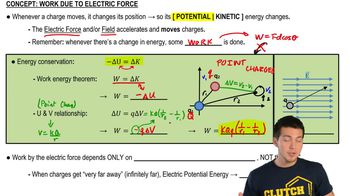
What is the formula for work done by an electric force when a charge moves through a potential difference?
The formula is W = -Q * ΔV, where Q is the charge and ΔV is the potential difference.
Why can't you use W = F * d * cos(θ) for point charges?
Because the electric force between point charges is not constant; it depends on the distance between them.
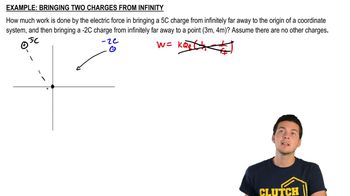
What is the formula for work done by electric force between two point charges?
The formula is W = k * Q * q * (1/r1 - 1/r2), where k is Coulomb's constant, Q and q are the charges, and r1 and r2 are the initial and final distances.
How is work calculated in a constant electric field?
Work is calculated as W = Q * E * d * cos(θ), where Q is the charge, E is the electric field, d is the displacement, and θ is the angle between force and displacement.
What does path independence mean in the context of electric force work?
It means the work done depends only on the initial and final positions, not the path taken between them.
What happens to electric potential energy as charges move infinitely far apart?
The electric potential energy approaches zero as the distance between charges becomes very large.
What does a negative value for work done by electric force indicate?
It indicates that work is done on the system, such as moving like charges closer together against their repulsion.
How do you determine which work formula to use in a problem involving electric forces?
You use the point charge formula if the force changes with distance, and the constant field formula if the electric field is uniform.
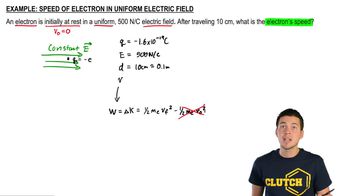
What is the relationship between work and kinetic energy according to the work-energy theorem?
The work done on an object equals the change in its kinetic energy.
How do you calculate the final speed of a charge after work is done on it, starting from rest?
Use v_final = sqrt(2 * Work / mass), where Work is the work done and mass is the charge's mass.
What is the significance of the angle θ in the formula W = Q * E * d * cos(θ)?
θ is the angle between the direction of the electric force and the displacement of the charge.
What is the formula for electric potential due to a point charge?
The formula is V = k * Q / r, where k is Coulomb's constant, Q is the charge, and r is the distance from the charge.
How does the work done by electric force relate to changes in potential energy?
Work done by electric force is equal to the negative change in electric potential energy.
In the example with two positive charges moved closer together, why is the work negative?
Because you are doing work against the repulsive electric force, requiring energy input to the system.
What happens to the electric force in a uniform electric field as a charge moves?
The electric force remains constant as the charge moves in a uniform electric field.
 Back
Back
 14:21
14:21