Skip to main content
Precalculus
My Course
Learn
Exam Prep
AI Tutor
Study Guides
Flashcards
Explore
Try the app
My Course
Learn
Exam Prep
AI Tutor
Study Guides
Flashcards
Explore
Try the app
Back
Common Functions definitions
You can tap to flip the card.
Constant Function
You can tap to flip the card.
👆
Constant Function
A function where every input yields the same output value, represented by a horizontal line on the graph.
Track progress
Control buttons has been changed to "navigation" mode.
1/14
Related flashcards
Related practice
Recommended videos
Common Functions quiz
Common Functions
15 Terms
Common Functions
3. Functions & Graphs
3 problems
Topic
Transformations
3. Functions & Graphs
6 problems
Topic
3. Functions & Graphs
5 topics
9 problems
Chapter
5:57
Graphs of Common Functions
3510
views
224
rank
1
comments
Terms in this set (14)
Hide definitions
Constant Function
A function where every input yields the same output value, represented by a horizontal line on the graph.
Identity Function
A function where each input value is matched to itself, resulting in a straight line through the origin.
Square Function
A function where each input is raised to the second power, producing a parabola opening upwards.
Cube Function
A function where each input is raised to the third power, resulting in a curve that passes through the origin and extends in all directions.
Square Root Function
A function that outputs the non-negative root of the input, defined only for non-negative values and increasing slowly.
Cube Root Function
A function that outputs the real root of the input, defined for all real numbers and symmetric about the origin.
Domain
The complete set of input values for which a function is defined, often spanning all real numbers or a restricted interval.
Range
The set of all possible output values a function can produce, determined by the function's rule and graph.
Parabola
A symmetric, bowl-shaped curve representing the graph of a quadratic function, opening either upward or downward.
Real Numbers
All numbers on the continuous number line, including both positive and negative values, zero, and irrational numbers.
Horizontal Line
A straight line on a graph with constant y-value, representing a function with no change in output.
Origin
The point (0,0) on a coordinate plane where the x-axis and y-axis intersect.
Output
The result produced by a function after substituting an input value, also known as the dependent variable.
Input
The value substituted into a function, determining the corresponding output, also called the independent variable.
 BackBack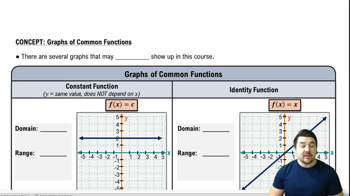
 5:57
5:57