Skip to main content
Precalculus
My Course
Learn
Exam Prep
AI Tutor
Study Guides
Flashcards
Explore
Try the app
My Course
Learn
Exam Prep
AI Tutor
Study Guides
Flashcards
Explore
Try the app
Back
Complex Numbers definitions
You can tap to flip the card.
Complex Number
You can tap to flip the card.
👆
Complex Number
An expression in the form a + bi, combining a real part and an imaginary part, where i is the imaginary unit.
Track progress
Control buttons has been changed to "navigation" mode.
1/15
Related flashcards
Related practice
Recommended videos
Complex Numbers quiz
Complex Numbers
15 Terms
Complex Numbers
1. Equations and Inequalities
3 problems
Topic
Intro to Quadratic Equations
1. Equations and Inequalities
4 problems
Topic
1. Equations and Inequalities - Part 1 of 2
7 topics
13 problems
Chapter
1. Equations and Inequalities - Part 2 of 2
5 topics
12 problems
Chapter
Guided course
03:31
Introduction to Complex Numbers
2633
views
102
rank
Guided course
04:22
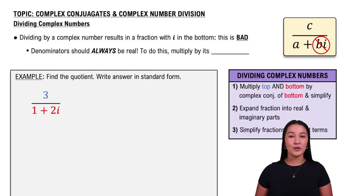
Dividing Complex Numbers
1345
views
39
rank
Guided course
05:33
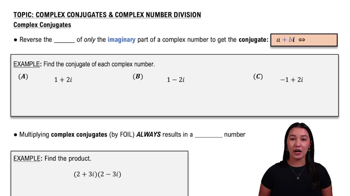
Complex Conjugates
1340
views
44
rank
Terms in this set (15)
Hide definitions
Complex Number
An expression in the form a + bi, combining a real part and an imaginary part, where i is the imaginary unit.
Real Part
The component 'a' in a + bi, representing the non-imaginary value in a complex number.
Imaginary Part
The coefficient 'b' in a + bi, indicating the value multiplied by the imaginary unit.
Imaginary Unit
A mathematical constant denoted as i, defined by the property that i squared equals negative one.
Standard Form
The arrangement of a complex number as a + bi, with the real part first and the imaginary part second.
Like Terms
Terms in an expression that share the same variable component, such as those with or without the imaginary unit.
Complex Conjugate
A related complex number formed by reversing the sign of the imaginary part in a + bi.
FOIL Method
A technique for multiplying two binomials, applying multiplication to first, outside, inside, and last terms.
Distributive Property
A rule allowing multiplication of a single term across terms within parentheses in an expression.
i Squared
A value resulting from multiplying the imaginary unit by itself, always equal to negative one.
Quotient
The result of dividing one complex number by another, often requiring rationalization of the denominator.
Rationalization
A process of eliminating the imaginary unit from a denominator by multiplying by the complex conjugate.
Binomial
An algebraic expression containing exactly two terms, such as a + bi.
Fraction Expansion
The separation of a complex fraction into distinct real and imaginary parts, each with the same denominator.
Multiplicative Identity
A property where multiplying by one leaves a number unchanged, used when multiplying numerator and denominator by the same value.
 BackBack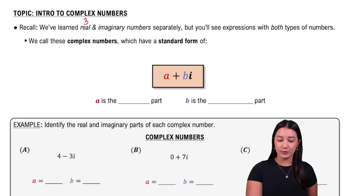
 03:31
03:31