Skip to main content
Precalculus
My Course
Learn
Exam Prep
AI Tutor
Study Guides
Flashcards
Explore
Try the app
My Course
Learn
Exam Prep
AI Tutor
Study Guides
Flashcards
Explore
Try the app
Back
Convert Points Between Polar and Rectangular Coordinates definitions
You can tap to flip the card.
Polar Coordinates
You can tap to flip the card.
👆
Polar Coordinates
A system representing points by a distance from the origin and an angle from the positive x-axis.
Track progress
Control buttons has been changed to "navigation" mode.
1/15
Related flashcards
Related practice
Recommended videos
Convert Points Between Polar and Rectangular Coordinates quiz
Convert Points Between Polar and Rectangular Coordinates
15 Terms
Convert Points Between Polar and Rectangular Coordinates
15. Polar Equations
3 problems
Topic
Convert Equations Between Polar and Rectangular Forms
15. Polar Equations
1 problem
Topic
15. Polar Equations
3 topics
5 problems
Chapter
Guided course
2:21
Convert Points from Rectangular to Polar Example 1
506
views
13
rank
Guided course
6:17
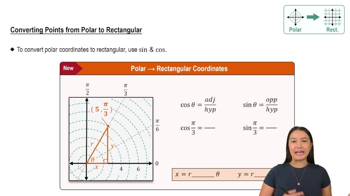
Convert Points from Polar to Rectangular
846
views
20
rank
Guided course
6:58
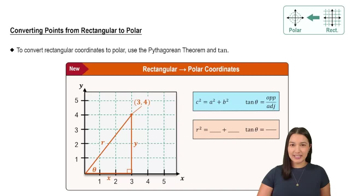
Convert Points from Rectangular to Polar
613
views
10
rank
Terms in this set (15)
Hide definitions
Polar Coordinates
A system representing points by a distance from the origin and an angle from the positive x-axis.
Rectangular Coordinates
A system representing points by horizontal (x) and vertical (y) distances from the origin.
Radius
The distance from the origin to a point in the polar coordinate system, often denoted as r.
Angle
The measure, usually in radians or degrees, from the positive x-axis to the line connecting the origin to a point.
Hypotenuse
The longest side of a right triangle, corresponding to the radius in polar coordinates.
Unit Circle
A circle with radius 1 centered at the origin, used as a reference for trigonometric values.
Cosine Function
A trigonometric function relating the adjacent side to the hypotenuse in a right triangle.
Sine Function
A trigonometric function relating the opposite side to the hypotenuse in a right triangle.
Tangent Function
A trigonometric function defined as the ratio of the opposite side to the adjacent side in a right triangle.
Inverse Tangent
A function used to determine the angle whose tangent is a given value, often needed for coordinate conversion.
Pythagorean Theorem
A geometric principle stating that the sum of the squares of the legs equals the square of the hypotenuse.
Quadrant
One of four regions in the coordinate plane, determined by the signs of x and y values.
Origin
The point (0,0) in rectangular coordinates or r = 0 in polar coordinates, serving as the reference point.
Quadrantal Angle
An angle whose terminal side lies along the x-axis or y-axis, such as 0, π/2, π, or 3π/2 radians.
Coordinate System
A method for uniquely identifying points in a plane using numbers, such as polar or rectangular formats.
 BackBack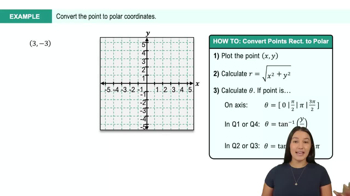
 2:21
2:21