Skip to main content
Precalculus
My Course
Learn
Exam Prep
AI Tutor
Study Guides
Flashcards
Explore
Try the app
My Course
Learn
Exam Prep
AI Tutor
Study Guides
Flashcards
Explore
Try the app
Back
Direction of a Vector definitions
You can tap to flip the card.
Vector
You can tap to flip the card.
👆
Vector
A quantity with both magnitude and direction, often represented as an arrow in a coordinate system.
Track progress
Control buttons has been changed to "navigation" mode.
1/15
Related flashcards
Related practice
Recommended videos
Direction of a Vector quiz
Direction of a Vector
15 Terms
Direction of a Vector
14. Vectors
3 problems
Topic
Unit Vectors and i & j Notation
14. Vectors
3 problems
Topic
14. Vectors
6 topics
11 problems
Chapter
04:19
Finding Direction of a Vector Example 1
479
views
8
rank
1
comments
05:13
Finding Direction of a Vector
644
views
10
rank
04:55
Finding Components from Direction and Magnitude
485
views
9
rank
Terms in this set (15)
Hide definitions
Vector
A quantity with both magnitude and direction, often represented as an arrow in a coordinate system.
Direction
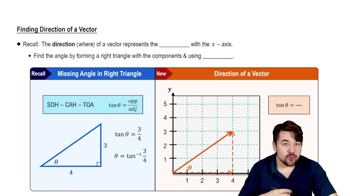
The angle measured from the positive x-axis to a vector, indicating its orientation in the plane.
Magnitude
The length or size of a vector, representing how much of the quantity is present.
Component
A part of a vector along a specific axis, typically described as x and y values in a coordinate system.
X Component
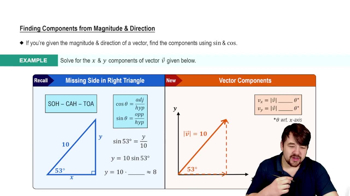
The horizontal part of a vector, found by multiplying the magnitude by the cosine of its direction angle.
Y Component
The vertical part of a vector, found by multiplying the magnitude by the sine of its direction angle.
Inverse Tangent
A trigonometric function used to determine the angle whose tangent is a given value, often for finding vector direction.
Quadrant
One of four regions in the coordinate plane, determined by the signs of the x and y components.
SOHCAHTOA
A mnemonic for remembering trigonometric ratios: sine, cosine, and tangent, useful for right triangle calculations.
Radian
A unit for measuring angles, where one full circle equals 2π radians.
Degree
A unit for measuring angles, where one full circle equals 360 units.
Positive X-Axis
The reference direction from which angles are typically measured in standard position.
Trigonometric Function
A mathematical function such as sine, cosine, or tangent, used to relate angles to side lengths in triangles.
Unit Circle
A circle with radius one, centered at the origin, used to define trigonometric values for all angles.
Right Triangle
A triangle with one 90-degree angle, often used to visualize vector components and directions.
 BackBack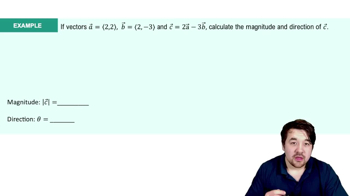
 04:19
04:19