Skip to main content
Precalculus
My Course
Learn
Exam Prep
AI Tutor
Study Guides
Flashcards
Explore
Try the app
My Course
Learn
Exam Prep
AI Tutor
Study Guides
Flashcards
Explore
Try the app
Back
Graphing Rational Functions definitions
You can tap to flip the card.
Rational Function
You can tap to flip the card.
👆
Rational Function
An expression formed by dividing one polynomial by another, often resulting in asymptotes and possible holes in its graph.
Track progress
Control buttons has been changed to "navigation" mode.
1/15
Related flashcards
Related practice
Recommended videos
Graphing Rational Functions quiz
Graphing Rational Functions
15 Terms
Graphing Rational Functions
5. Rational Functions
4 problems
Topic
Asymptotes
5. Rational Functions
3 problems
Topic
5. Rational Functions
3 topics
5 problems
Chapter
Guided course
10:18
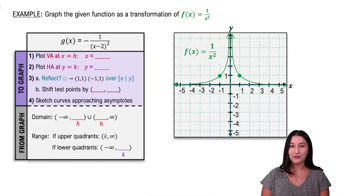
Example 1
851
views
10
rank
Guided course
8:19
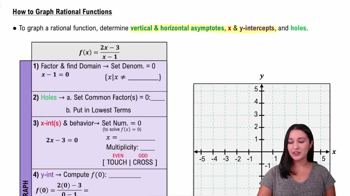
How to Graph Rational Functions
1092
views
16
rank
1
comments
Guided course
3:08
Example 1
1152
views
21
rank
2
comments
Terms in this set (15)
Hide definitions
Rational Function
An expression formed by dividing one polynomial by another, often resulting in asymptotes and possible holes in its graph.
Transformation
A change applied to a graph, such as shifting, reflecting, or stretching, altering its position or orientation.
Reflection
A flip of a graph over a specific axis, caused by a negative sign inside or outside the function.
Horizontal Shift
A movement of a graph left or right, determined by the value subtracted or added to the input variable.
Vertical Shift
A movement of a graph up or down, determined by a constant added or subtracted outside the function.
Vertical Asymptote
A vertical dashed line on a graph where the function approaches infinity, found by setting the denominator to zero.
Horizontal Asymptote
A horizontal dashed line indicating the value a function approaches as x becomes very large or small.
Domain
The set of all possible input values for which a function is defined, often excluding values causing division by zero.
Range
The set of all possible output values a function can produce, often split by horizontal asymptotes.
Set Notation
A mathematical way to describe collections of numbers, often using unions and parentheses to indicate intervals.
Hole
A point where a function is undefined due to a common factor in the numerator and denominator, resulting in a gap in the graph.
X-Intercept
A point where the graph crosses the x-axis, found by setting the numerator equal to zero.
Y-Intercept
A point where the graph crosses the y-axis, found by evaluating the function at zero.
Multiplicity
The number of times a factor appears in a polynomial, affecting whether a graph crosses or touches the axis at an intercept.
Interval
A section of the x-axis between known components like asymptotes and intercepts, used to analyze function behavior.
 BackBack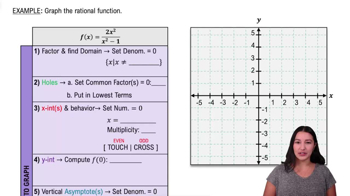
 10:18
10:18