Which expression gives the length of the transverse axis of a hyperbola centered at the origin?
The length of the transverse axis of a hyperbola centered at the origin is 2a, where 'a' is the distance from the center to each vertex.
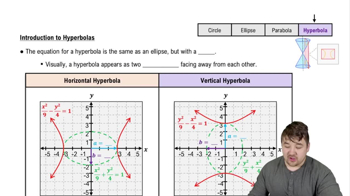
What is the key difference in the standard equations of ellipses and hyperbolas?
The standard equation for a hyperbola has a minus sign between the squared terms, while the ellipse has a plus sign. This sign change leads to very different graph shapes.
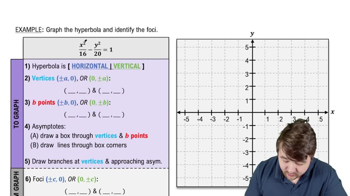
How do you determine if a hyperbola is horizontal or vertical from its equation?
Check which variable's squared term comes first in the standard form; if x^2 comes first, it's horizontal, and if y^2 comes first, it's vertical. The orientation affects the placement of vertices and foci.
What does the 'b' value represent when graphing a hyperbola at the origin?
For hyperbolas, 'b' helps determine the height and is used to construct the rectangle for drawing asymptotes. It does not represent a semi-minor axis as it does for ellipses.
How do you find the coordinates of the vertices for a vertical hyperbola centered at the origin?
The vertices are located at (0, a) and (0, -a), where 'a' is the square root of the first denominator term. This is because the vertical orientation places the vertices along the y-axis.
What is the relationship between the distances from any point on a hyperbola to its foci?
The absolute difference of the distances from any point on the hyperbola to the two foci is constant. This property distinguishes hyperbolas from other conic sections.
What formula is used to find the distance from the center to the foci of a hyperbola?
The formula is c^2 = a^2 + b^2, where 'c' is the distance from the center to each focus. This differs from the ellipse, which uses c^2 = a^2 - b^2.
How do you graph the asymptotes of a hyperbola centered at the origin?
Draw a rectangle using the 'a' and 'b' values from the equation, then draw lines through the diagonals of the rectangle. These lines are the asymptotes that the hyperbola approaches.
What are the equations of the asymptotes for a vertical hyperbola at the origin?
The equations are y = ±(a/b)x, where 'a' and 'b' are from the denominators of the standard form. The slopes are determined by the ratio of 'a' to 'b'.
What is the final step when graphing a hyperbola from its equation at the origin?
After drawing the asymptotes and identifying the vertices, sketch the two branches of the hyperbola so they pass through the vertices and approach the asymptotes. This completes the graph.
 Back
Back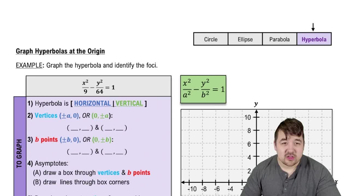
 04:20
04:20