Skip to main content
Precalculus
My Course
Learn
Exam Prep
AI Tutor
Study Guides
Flashcards
Explore
Try the app
My Course
Learn
Exam Prep
AI Tutor
Study Guides
Flashcards
Explore
Try the app
Back
Hyperbolas NOT at the Origin definitions
You can tap to flip the card.
Hyperbola
You can tap to flip the card.
👆
Hyperbola
A conic section with two separate branches, defined by a specific quadratic equation, often centered at a point other than the origin.
Track progress
Control buttons has been changed to "navigation" mode.
1/15
Related flashcards
Related practice
Recommended videos
Hyperbolas NOT at the Origin quiz
Hyperbolas NOT at the Origin
15 Terms
Hyperbolas NOT at the Origin
19. Conic Sections
5 problems
Topic
Hyperbolas at the Origin
19. Conic Sections
4 problems
Topic
19. Conic Sections
6 topics
9 problems
Chapter
05:59
Graph Hyperbolas NOT at the Origin
604
views
9
rank
Terms in this set (15)
Hide definitions
Hyperbola
A conic section with two separate branches, defined by a specific quadratic equation, often centered at a point other than the origin.
Center
The point (h, k) representing the midpoint between the vertices and foci, determined by values subtracted from x and y in the equation.
Vertex
A point on the hyperbola closest to the center, found by adding and subtracting 'a' from the center's coordinates.
Asymptote
A straight line that the branches of the hyperbola approach but never touch, found by drawing lines through the corners of a guiding box.
Branch
One of the two separate curves of a hyperbola, each extending outward and approaching the asymptotes.
Foci
Two fixed points inside each branch, located using the relationship c² = a² + b², which help define the hyperbola's shape.
Standard Equation
The general form of a hyperbola's equation, modified by shifting the center to (h, k) using subtracted values.
Horizontal Hyperbola
A hyperbola with branches opening left and right, identified when the x-term appears first in the equation.
Vertical Hyperbola
A hyperbola with branches opening up and down, identified when the y-term appears first in the equation.
a-value
The distance from the center to each vertex, found by taking the square root of the first denominator in the equation.
b-value
The distance from the center to the sides of the guiding box, found by taking the square root of the second denominator.
c-value
The distance from the center to each focus, calculated using the formula c² = a² + b².
Guiding Box
A rectangle drawn using the a and b distances from the center, used to help locate asymptotes and sketch the hyperbola.
Conic Section
A curve formed by the intersection of a plane and a double-napped cone, including hyperbolas, ellipses, circles, and parabolas.
Transformation
A shift or change in the position of a graph, such as moving the center of a hyperbola from the origin to (h, k).
 BackBack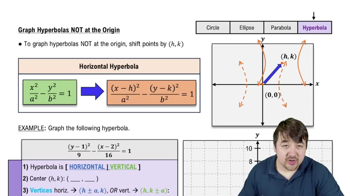
 05:59
05:59