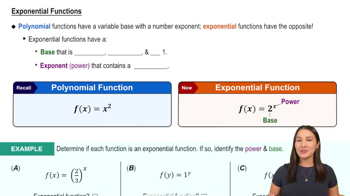
A graph represents an exponential function if its equation has a constant base raised to a variable exponent, such as f(x) = 2^x. The graph typically shows rapid growth or decay, curving upward or downward, and never touches the x-axis.
What must be true about the base of an exponential function for it to be valid?
The base must be a constant, positive number that is not equal to one. If any of these conditions are not met, the function is not considered exponential.
Why is f(y) = 1^y not considered an exponential function?
Because the base is 1, which violates the rule that the base cannot be equal to one. As a result, the output is always 1 regardless of the exponent.
How do you evaluate an exponential function when the exponent is negative?
A negative exponent means you take the reciprocal of the base raised to the positive exponent. For example, 2^-3 equals 1 divided by 2^3, which is 1/8.
What is the process for evaluating an exponential function with a non-integer exponent like 2^3.14?
You use a calculator to compute the value by entering the base, using the caret key for the exponent, and typing in the non-integer exponent. This gives an approximate decimal result.
If the exponent in an exponential function is x+1, what is considered the power?
The entire expression x+1 is the power. The power is everything the base is being raised to, not just the variable.
What happens if the base of an exponential function is a fraction like 2/3?
As long as the fraction is constant and positive and not equal to one, it is a valid base for an exponential function. The function will still exhibit exponential behavior.
How do you use a calculator to evaluate 2^12?
Enter 2, use the caret key (^), then enter 12, and the calculator will display the result. For 2^12, the answer is 4,096.
What distinguishes an exponential function from a polynomial function in terms of variable placement?
In an exponential function, the variable is in the exponent, while in a polynomial function, the variable is the base. This difference changes the function's growth behavior.
Why is it important to use parentheses when entering exponents with more than one term into a calculator?
Parentheses ensure the entire exponent is included in the calculation, especially if it is an expression like x+1. This prevents errors in evaluating the function.