Introduction to Logarithms definitions Flashcards

Introduction to Logarithms definitions
Control buttons has been changed to "navigation" mode.
1/15
  • Logarithm
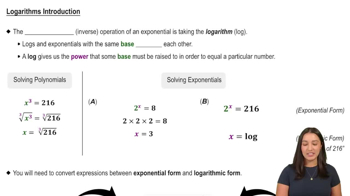
    Inverse operation to exponentiation, providing the power a base must be raised to in order to yield a specific number.
  • Exponential Equation
    Mathematical statement where the variable appears in the exponent, such as 2^x = 8.
  • Logarithmic Form
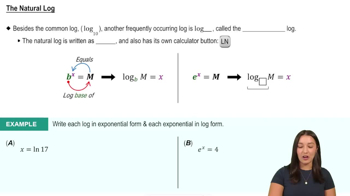
    Expression written as log base b of m equals x, representing the exponent needed for b to yield m.
  • Exponential Form
    Expression written as b to the power of x equals m, showing a base raised to an exponent.
  • Base
    Number that is repeatedly multiplied in exponentiation or used as the reference in a logarithm.
  • Common Logarithm
    Logarithm with base 10, often written simply as 'log' and commonly found on calculators.
  • Natural Logarithm
    Logarithm with base e, denoted as 'ln', frequently used in mathematics and science.
  • Inverse Property
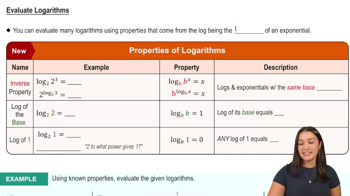
    Rule stating that a logarithm and an exponential with the same base cancel, leaving only the exponent or argument.
  • Exponent
    Number indicating how many times a base is multiplied by itself in an exponential expression.
  • Cube Root
    Value that, when multiplied by itself three times, yields the original number; used to reverse cubing.
  • Logarithmic Equation
    Equation involving a logarithm, often used to solve for exponents in exponential equations.
  • Logarithmic Property
    Characteristic or rule that simplifies or evaluates logarithmic expressions, such as log base b of b equals 1.
  • Equivalent Statement
    Two mathematical expressions, such as exponential and logarithmic forms, that represent the same relationship.
  • Calculator Notation
    Special symbols or buttons, like 'log' for base 10 and 'ln' for base e, used for evaluating logarithms.
  • Exponent Rule
    Guideline for manipulating exponents, such as converting roots to fractional exponents for use in logarithms.