Skip to main content
Precalculus
My Course
Learn
Exam Prep
AI Tutor
Study Guides
Flashcards
Explore
Try the app
My Course
Learn
Exam Prep
AI Tutor
Study Guides
Flashcards
Explore
Try the app
Back
Introduction to Trigonometric Identities definitions
You can tap to flip the card.
Even Function
You can tap to flip the card.
👆
Even Function
A function whose graph is symmetric about the y-axis, producing identical outputs for positive and negative inputs.
Track progress
Control buttons has been changed to "navigation" mode.
1/15
Related flashcards
Related practice
Recommended videos
Introduction to Trigonometric Identities quiz
Introduction to Trigonometric Identities
15 Terms
Introduction to Trigonometric Identities
12. Trigonometric Identities
7 problems
Topic
Sum and Difference Identities
12. Trigonometric Identities
5 problems
Topic
12. Trigonometric Identities
4 topics
8 problems
Chapter
Guided course
6:36
Simplifying Trig Expressions
1268
views
33
rank
Guided course
2:20
Example 1
1993
views
54
rank
Guided course
5:18
Example 4
988
views
40
rank
1
comments
Terms in this set (15)
Hide definitions
Even Function
A function whose graph is symmetric about the y-axis, producing identical outputs for positive and negative inputs.
Odd Function
A function whose graph is symmetric about the origin, with outputs for negative inputs being the negatives of those for positive inputs.
Argument
The value or expression inside the parentheses of a trigonometric function, such as the angle in sine or cosine.
Pythagorean Identity
An equation relating squared trigonometric functions, derived from the Pythagorean theorem, true for all angle values.
Unit Circle
A circle with radius one, centered at the origin, used to define trigonometric function values for all angles.
Difference of Squares
An algebraic pattern where the product of a sum and difference yields the difference between two squares.
Secant
A trigonometric function defined as the reciprocal of cosine, often used in identities and simplifications.
Cosecant
A trigonometric function defined as the reciprocal of sine, appearing in various trigonometric identities.
Cotangent
A trigonometric function defined as the ratio of cosine to sine, or the reciprocal of tangent.
Identity
An equation involving trigonometric functions that holds true for all permissible values of the variables involved.
Simplification
The process of rewriting a trigonometric expression to have positive arguments, no fractions, and the fewest functions possible.
Verification
The process of demonstrating that both sides of a trigonometric equation are equal by applying identities and simplification.
Reciprocal Function
A trigonometric function that is the inverse of another, such as secant for cosine or cosecant for sine.
Squared Trigonometric Function
A trigonometric function raised to the second power, commonly appearing in Pythagorean identities.
Symmetry
A property of a function's graph indicating invariance under certain transformations, such as reflection about the y-axis or origin.
 BackBack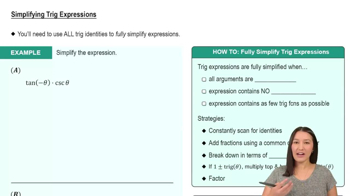
 6:36
6:36