Skip to main content
Precalculus
My Course
Learn
Exam Prep
AI Tutor
Study Guides
Flashcards
Explore
Try the app
My Course
Learn
Exam Prep
AI Tutor
Study Guides
Flashcards
Explore
Try the app
Back
Law of Sines definitions
1 student found this helpful
You can tap to flip the card.
Law of Sines
You can tap to flip the card.
👆
Law of Sines
A trigonometric equation relating the ratios of the sines of angles to their opposite sides in any triangle, useful for non-right triangles.
Track progress
Control buttons has been changed to "navigation" mode.
1/15
Related flashcards
Related practice
Recommended videos
Law of Sines quiz
Law of Sines
15 Terms
Law of Sines
13. Non-Right Triangles
5 problems
Topic
Law of Cosines
13. Non-Right Triangles
5 problems
Topic
13. Non-Right Triangles
3 topics
8 problems
Chapter
4:02
Solving SSA Triangles ("Ambiguous" Case) Example 1
764
views
21
rank
9:50
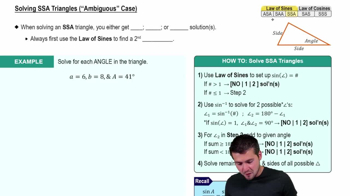
Solving SSA Triangles ("Ambiguous" Case)
988
views
24
rank
7:23
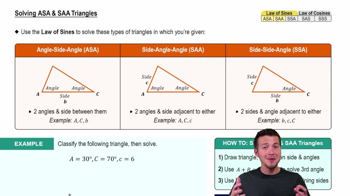
Solving SAA & ASA Triangles
1064
views
27
rank
Terms in this set (15)
Hide definitions
Law of Sines
A trigonometric equation relating the ratios of the sines of angles to their opposite sides in any triangle, useful for non-right triangles.
Non-right Triangle
A triangle in which none of the angles measures 90 degrees, requiring different methods than SOHCAHTOA or the Pythagorean theorem.
Angle-Side-Angle (ASA)
A triangle classification where two angles and the included side are known, allowing for complete solution using the law of sines.
Side-Angle-Angle (SAA)
A triangle classification where two angles and a non-included side are given, often solved by first finding the third angle.
Side-Side-Angle (SSA)
A triangle classification with two sides and a non-included angle, known for potentially yielding zero, one, or two solutions.
Ambiguous Case
A scenario in SSA triangles where the given information can result in multiple possible triangle solutions or none at all.
Angle Sum Formula
A geometric rule stating that the sum of the interior angles in any triangle is always 180 degrees.
Unit Circle
A mathematical tool used to explain why the sine of an angle can correspond to two different angle measures between 0° and 180°.
Inverse Sine
A function used to determine an angle when its sine value is known, often producing two possible results in triangle problems.
Ratio
A comparison of two quantities, such as the sine of an angle to its opposite side, fundamental to the law of sines.
Greek Symbols
Alternative notation for triangle angles, such as alpha, beta, and gamma, often used in place of A, B, and C.
Obtuse Angle
An angle greater than 90 degrees but less than 180 degrees, which can appear as a solution in ambiguous SSA cases.
Acute Angle
An angle less than 90 degrees, commonly found in triangle solutions, especially in non-ambiguous cases.
Cross Multiplication
An algebraic technique used to solve proportions, such as those found in the law of sines equations.
Triangle Classification
A method of categorizing triangles based on known sides and angles, guiding the approach to solving for unknowns.
 BackBack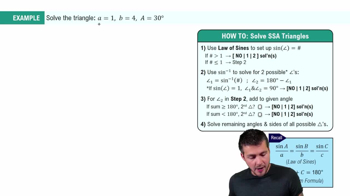
 4:02
4:02