Skip to main content
Precalculus
My Course
Learn
Exam Prep
AI Tutor
Study Guides
Flashcards
Explore
Try the app
My Course
Learn
Exam Prep
AI Tutor
Study Guides
Flashcards
Explore
Try the app
Back
Limits of Sequences definitions
You can tap to flip the card.
Sequence
You can tap to flip the card.
👆
Sequence
A list of numbers generated by a rule, with each term corresponding to a discrete input, often following a recognizable pattern.
Track progress
Control buttons has been changed to "navigation" mode.
1/15
Related flashcards
Related practice
Recommended videos
Limits of Sequences quiz
Limits of Sequences
15 Terms
Limits of Sequences
23. Intro to Derivatives & Area Under the Curve
5 problems
Topic
Area Under a Curve
23. Intro to Derivatives & Area Under the Curve
5 problems
Topic
23. Intro to Derivatives & Area Under the Curve
4 topics
12 problems
Chapter
04:53
Limits of Sequences
326
views
4
rank
Terms in this set (15)
Hide definitions
Sequence
A list of numbers generated by a rule, with each term corresponding to a discrete input, often following a recognizable pattern.
Discrete Input
A set of specific, separate values such as 1, 2, 3, used as the domain for sequences instead of a continuous range.
Limit
The value a sequence approaches as its input grows without bound, revealing long-term behavior.
Infinity
A concept representing an unbounded quantity, often used to describe the behavior of sequences as inputs increase endlessly.
Convergence
A property where sequence terms get arbitrarily close to a specific value as the input becomes very large.
Divergence
A situation where sequence terms fail to approach a single value as the input increases, either oscillating or growing without bound.
Oscillation
A pattern where sequence values alternate between two or more numbers, preventing approach to a single limit.
Table of Values
A method of listing sequence terms for various inputs to observe trends and infer long-term behavior.
Fraction
An expression representing division, often used in sequence formulas to analyze how terms behave as the input increases.
Pattern
A regular, predictable arrangement in the terms of a sequence, often used to deduce future values.
Rational Function
A function or sequence term expressed as the ratio of two polynomials, whose behavior at infinity is key to limit analysis.
Output
The value produced by a sequence for a given input, forming the list of terms.
Term
An individual element in a sequence, determined by applying the sequence's rule to a specific input.
Input
The position number in a sequence, typically represented by n, which determines the corresponding term.
Behavior at Infinity
The trend or pattern shown by sequence terms as the input grows larger and larger.
 BackBack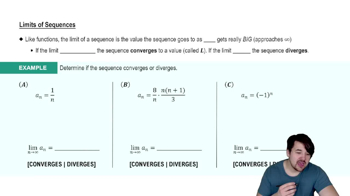
 04:53
04:53