Skip to main content
Precalculus
My Course
Learn
Exam Prep
AI Tutor
Study Guides
Flashcards
Explore
Try the app
My Course
Learn
Exam Prep
AI Tutor
Study Guides
Flashcards
Explore
Try the app
Back
Phase Shifts definitions
You can tap to flip the card.
Phase Shift
You can tap to flip the card.
👆
Phase Shift
A horizontal translation of a sine or cosine graph, moving every point left or right by a specific amount.
Track progress
Control buttons has been changed to "navigation" mode.
1/15
Related flashcards
Related practice
Recommended videos
Phase Shifts quiz
Phase Shifts
15 Terms
Phase Shifts
10. Graphing Trigonometric Functions
3 problems
Topic
Graphs of Secant and Cosecant Functions
10. Graphing Trigonometric Functions
3 problems
Topic
10. Graphing Trigonometric Functions
4 topics
7 problems
Chapter
6:31
Phase Shifts
1498
views
19
rank
1
comments
3:42
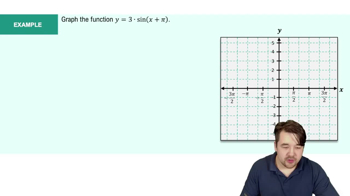
Example 1
801
views
31
rank
Terms in this set (15)
Hide definitions
Phase Shift
A horizontal translation of a sine or cosine graph, moving every point left or right by a specific amount.
Horizontal Shift
A transformation that moves a graph along the x-axis, altering the starting position of its wave pattern.
Sine Function
A periodic trigonometric function with a wave-like graph, starting at zero and oscillating between -1 and 1.
Cosine Function
A periodic trigonometric function with a wave-like graph, starting at one and oscillating between -1 and 1.
Period
The horizontal length required for a sine or cosine graph to complete one full cycle, calculated as 2π divided by b.
Amplitude
The maximum vertical distance from the midline to the peak or trough of a sine or cosine graph.
h Value
The constant added or subtracted inside the function, determining the amount and direction of the phase shift.
b Value
The coefficient of x inside the function, affecting both the period and the calculation of the phase shift.
Wave Pattern
The repeating up-and-down shape characteristic of sine and cosine graphs.
Transformation
Any change to a graph's position, shape, or size, such as shifting, stretching, or compressing.
Trigonometric Function
A function involving angles, commonly sine or cosine, that produces periodic wave-like graphs.
π (Pi)
A mathematical constant approximately equal to 3.1416, often used to describe intervals and shifts in trigonometric graphs.
Full Period
The interval over which a trigonometric graph completes one entire cycle before repeating.
Midline
The horizontal axis that runs through the center of a sine or cosine graph, equidistant from its peaks and troughs.
Out of Phase
A condition where two wave graphs have identical shapes but are horizontally shifted relative to each other.
 BackBack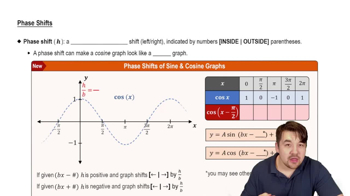
 6:31
6:31