Skip to main content
Precalculus
My Course
Learn
Exam Prep
AI Tutor
Study Guides
Flashcards
Explore
Try the app
My Course
Learn
Exam Prep
AI Tutor
Study Guides
Flashcards
Explore
Try the app
Back
Powers of Complex Numbers (DeMoivre's Theorem) definitions
You can tap to flip the card.
Polar Form
You can tap to flip the card.
👆
Polar Form
A representation of complex numbers using a modulus and an angle, often written as r cis θ or r(cos θ + i sin θ).
Track progress
Control buttons has been changed to "navigation" mode.
1/15
Related flashcards
Related practice
Recommended videos
Powers of Complex Numbers (DeMoivre's Theorem) quiz
Powers of Complex Numbers (DeMoivre's Theorem)
15 Terms
Powers of Complex Numbers (DeMoivre's Theorem)
17. Graphing Complex Numbers
5 problems
Topic
Products and Quotients of Complex Numbers
17. Graphing Complex Numbers
3 problems
Topic
17. Graphing Complex Numbers
4 topics
7 problems
Chapter
03:05
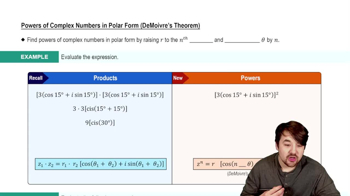
Powers Of Complex Numbers In Polar Form (DeMoivre's Theorem) Example 1
393
views
9
rank
03:41
Powers Of Complex Numbers In Polar Form (DeMoivre's Theorem)
581
views
8
rank
07:37
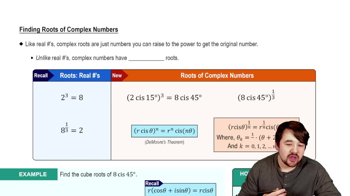
Complex Roots
467
views
5
rank
Terms in this set (15)
Hide definitions
Polar Form
A representation of complex numbers using a modulus and an angle, often written as r cis θ or r(cos θ + i sin θ).
Modulus
The distance from the origin to the point representing a complex number in the complex plane, denoted as r.
Argument
The angle measured from the positive real axis to the line representing a complex number in polar form, denoted as θ.
De Moivre's Theorem
A shortcut for raising complex numbers in polar form to integer powers by exponentiating the modulus and multiplying the angle.
cis Notation
A shorthand for cos θ + i sin θ, used to simplify expressions of complex numbers in polar form.
Root of Unity
A solution to the equation z^n = 1 in the complex plane, resulting in multiple equally spaced points on the unit circle.
Principal Root
The primary or first solution when extracting roots of a complex number, typically corresponding to k = 0.
Multiple Roots
The phenomenon where extracting roots of a complex number yields several distinct solutions due to periodicity.
Periodicity
The property of complex numbers where adding full rotations (360° or 2π) to the angle results in the same point.
Exponent
The integer or fractional power to which a complex number is raised, affecting both modulus and argument.
Radians
A unit for measuring angles, where a full circle is 2π radians, often used in complex number calculations.
Degrees
A unit for measuring angles, where a full circle is 360°, commonly used in polar form representations.
k Value
An integer parameter used to enumerate all possible roots of a complex number, ranging from 0 to n-1.
Complex Plane
A two-dimensional plane where complex numbers are represented, with the real part on the x-axis and imaginary part on the y-axis.
Full Rotation
An addition of 360° or 2π to an angle, resulting in the same position in the complex plane due to periodicity.
 BackBack
 03:05
03:05