Skip to main content
Precalculus
My Course
Learn
Exam Prep
AI Tutor
Study Guides
Flashcards
Explore
Try the app
My Course
Learn
Exam Prep
AI Tutor
Study Guides
Flashcards
Explore
Try the app
Back
Probability definitions
You can tap to flip the card.
Probability
You can tap to flip the card.
👆
Probability
A numerical measure expressing the likelihood of an event, ranging from 0 (impossible) to 1 (certain).
Track progress
Control buttons has been changed to "navigation" mode.
1/15
Related flashcards
Related practice
Recommended videos
Probability quiz
Probability
15 Terms
Probability
21. Combinatorics and Probability
4 problems
Topic
Combinatorics
21. Combinatorics and Probability
5 problems
Topic
21. Combinatorics and Probability
3 topics
5 problems
Chapter
Guided course
02:57
Probability of Non-Mutually Exclusive Events Example
379
views
3
rank
Guided course
04:23
Complementary Events
313
views
6
rank
Guided course
03:59
Introduction to Probability Example
391
views
8
rank
Terms in this set (15)
Hide definitions
Probability
A numerical measure expressing the likelihood of an event, ranging from 0 (impossible) to 1 (certain).
Event
A specific outcome or set of outcomes from a random process, such as rolling a die or drawing a card.
Theoretical Probability
A ratio based on possible outcomes, calculated before any experiment is performed.
Empirical Probability
A ratio based on actual results from experiments or collected data, reflecting observed frequencies.
Sample Space
A set containing all possible outcomes of a random experiment, often shown in curly brackets.
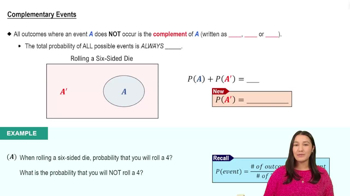
Complement
All outcomes in the sample space that are not part of a specified event.
Mutually Exclusive Events
Events that cannot occur at the same time; their occurrence is completely separate.
Non-Mutually Exclusive Events
Events that can occur simultaneously, sharing some overlapping outcomes.
Independent Events
Events where the outcome of one does not affect the outcome of the other.
Dependent Events
Events where the outcome of one influences the outcome of the other.
Addition Rule
A method for finding the probability of at least one of multiple events, adjusted for overlap if needed.
Multiplication Rule
A method for finding the probability of multiple independent events all occurring, by multiplying their probabilities.
Set Notation
A mathematical way to represent collections of outcomes, often using symbols like U (union) and ∩ (intersection).
Union
The set of outcomes that belong to at least one of two events, represented by the symbol U.
Intersection
The set of outcomes shared by two events, represented by the symbol ∩.
 BackBack
 02:57
02:57