Properties of Logarithms definitions Flashcards

Properties of Logarithms definitions
Control buttons has been changed to "navigation" mode.
1/15
  • Logarithmic Expression
    Mathematical statement involving a logarithm, often manipulated using properties to expand or condense its form.
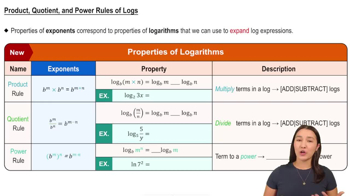
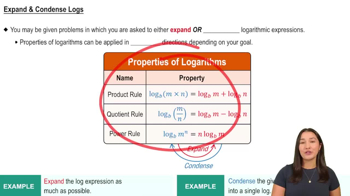
  • Product Rule
    Property allowing the log of a product to be written as the sum of the logs of its factors.
  • Quotient Rule
    Property allowing the log of a quotient to be written as the difference of the logs of numerator and denominator.
  • Power Rule
    Property allowing an exponent inside a log to be moved in front as a multiplier.
  • Expansion
    Process of rewriting a single log expression as a sum or difference of multiple logs using log properties.
  • Condensation
    Process of combining multiple log terms into a single log expression by applying log properties in reverse.
  • Base
    Number that serves as the reference for the logarithm, found as the subscript in log notation.
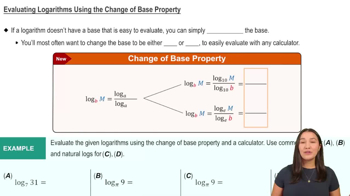
  • Change of Base Formula
    Method for rewriting a log in terms of logs with a different base, often to simplify calculation.
  • Common Logarithm
    Logarithm with base 10, typically written as 'log' and available as a calculator function.
  • Natural Logarithm
    Logarithm with base e, written as 'ln', commonly used in mathematics and available on calculators.
  • Exponent
    Number indicating how many times a base is multiplied by itself, often manipulated using the power rule in logs.
  • Calculator Evaluation
    Process of using a calculator to compute the value of a log, often after changing its base to 10 or e.
  • Single Log
    Logarithmic expression condensed into one term, often the result of applying condensation.
  • Multiple Logs
    Expanded form of a log expression, consisting of several log terms connected by addition or subtraction.
  • Logarithmic Base e
    Special base for logs, denoted as e (approximately 2.718), used in natural logarithms.