Skip to main content
Precalculus
My Course
Learn
Exam Prep
AI Tutor
Study Guides
Flashcards
Explore
Try the app
My Course
Learn
Exam Prep
AI Tutor
Study Guides
Flashcards
Explore
Try the app
Back
Reciprocal Trigonometric Functions on the Unit Circle definitions
You can tap to flip the card.
Unit Circle
You can tap to flip the card.
👆
Unit Circle
A circle with radius 1 centered at the origin, used to define trigonometric function values based on coordinates.
Track progress
Control buttons has been changed to "navigation" mode.
1/14
Related flashcards
Related practice
Recommended videos
Reciprocal Trigonometric Functions on the Unit Circle quiz
Reciprocal Trigonometric Functions on the Unit Circle
15 Terms
Reciprocal Trigonometric Functions on the Unit Circle
9. Unit Circle
3 problems
Topic
Reference Angles
9. Unit Circle
5 problems
Topic
9. Unit Circle
5 topics
10 problems
Chapter
Guided course
3:23
Secant, Cosecant, & Cotangent on the Unit Circle
1478
views
37
rank
Terms in this set (14)
Hide definitions
Unit Circle
A circle with radius 1 centered at the origin, used to define trigonometric function values based on coordinates.
Sine
A trigonometric function representing the y-coordinate of a point on the unit circle at a given angle.
Cosine
A trigonometric function representing the x-coordinate of a point on the unit circle at a given angle.
Tangent
A trigonometric function found by dividing the y-coordinate by the x-coordinate on the unit circle.
Cosecant
A reciprocal trigonometric function equal to one divided by the y-coordinate on the unit circle.
Secant
A reciprocal trigonometric function equal to one divided by the x-coordinate on the unit circle.
Cotangent
A reciprocal trigonometric function equal to the x-coordinate divided by the y-coordinate on the unit circle.
Reciprocal Trigonometric Functions
Functions obtained by taking the reciprocal of sine, cosine, and tangent, resulting in cosecant, secant, and cotangent.
Angle
A measure, often in degrees or radians, that determines a point's position on the unit circle.
Pi Over Six
A specific angle on the unit circle, equivalent to 30 degrees, often used in trigonometric examples.
Pi Over Four
A specific angle on the unit circle, equivalent to 45 degrees, where x and y coordinates are equal.
Reciprocal
A mathematical operation that inverts a value, such as flipping a fraction or taking one divided by a number.
X Value
The horizontal coordinate of a point on the unit circle, representing the cosine of an angle.
Y Value
The vertical coordinate of a point on the unit circle, representing the sine of an angle.
 BackBack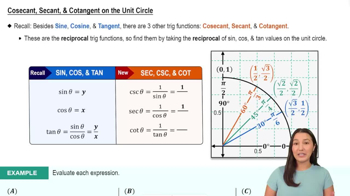
 3:23
3:23