Skip to main content
Precalculus
My Course
Learn
Exam Prep
AI Tutor
Study Guides
Flashcards
Explore
Try the app
My Course
Learn
Exam Prep
AI Tutor
Study Guides
Flashcards
Explore
Try the app
Back
Reference Angles definitions
You can tap to flip the card.
Reference Angle
You can tap to flip the card.
👆
Reference Angle
Smallest positive angle formed between a given angle's terminal side and the nearest x-axis, always corresponding to a quadrant 1 angle.
Track progress
Control buttons has been changed to "navigation" mode.
1/15
Related flashcards
Related practice
Recommended videos
Reference Angles quiz
Reference Angles
15 Terms
Reference Angles
9. Unit Circle
5 problems
Topic
Reciprocal Trigonometric Functions on the Unit Circle
9. Unit Circle
3 problems
Topic
9. Unit Circle
5 topics
10 problems
Chapter
Guided course
5:31
Reference Angles on the Unit Circle
1561
views
35
rank
Guided course
3:47
Coterminal Angles on the Unit Circle
880
views
26
rank
Guided course
3:03
Example 1
910
views
21
rank
Terms in this set (15)
Hide definitions
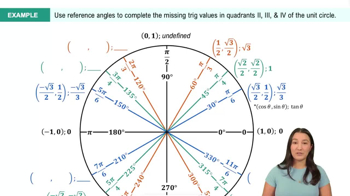
Reference Angle
Smallest positive angle formed between a given angle's terminal side and the nearest x-axis, always corresponding to a quadrant 1 angle.
Unit Circle
A circle centered at the origin with radius 1, used to define trigonometric values for all angles.
Quadrant
One of four sections of the coordinate plane, each determining the sign of trigonometric values.
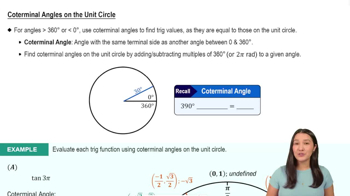
Coterminal Angle
Angles sharing the same terminal side, differing by full rotations of 360° or 2π radians.
Terminal Side
The position of a ray after rotation from the initial side, used to determine angle placement.
Initial Side
The starting position of a ray before rotation, typically along the positive x-axis.
Sine
Trigonometric function representing the y-coordinate of a point on the unit circle.
Cosine
Trigonometric function representing the x-coordinate of a point on the unit circle.
Tangent
Trigonometric function found by dividing sine by cosine, or y-coordinate by x-coordinate.
Radian
Angle measure based on arc length, where 2π radians equals a full circle.
Sign Convention
Rule determining whether trigonometric values are positive or negative based on quadrant location.
ASTC Mnemonic
Phrase 'All Students Take Calculus' used to remember which trigonometric functions are positive in each quadrant.
Full Rotation
A complete turn around the circle, equal to 360 degrees or 2π radians.
X-Axis
Horizontal axis in the coordinate plane, used as a reference for measuring angles.
Y-Axis
Vertical axis in the coordinate plane, used to determine the sign of sine values.
 BackBack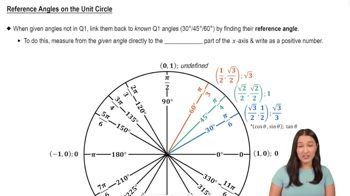
 5:31
5:31