Pearson+ LogoPearson+ Logo

Sequences quiz #1 Flashcards

Back
Sequences quiz #1
Control buttons has been changed to "navigation" mode.
1/10
  • How do you determine the next term in a sequence when given a list of numbers, such as 9, 16, 24?

    To find the next term in a sequence, identify the pattern between the numbers. For example, if the sequence is 9, 16, 24, calculate the differences: 16 - 9 = 7 and 24 - 16 = 8. If the pattern is an increasing difference, continue the pattern by adding the next difference (which would be 9) to the last term: 24 + 9 = 33. Thus, the next term is 33.
  • What steps should you follow to find the next term in a sequence such as 710, 1628?

    To find the next term in a sequence, examine the pattern or rule connecting the terms. Calculate the difference or ratio between terms (e.g., 1628 - 710 = 918). If the pattern is a constant difference, add it to the last term. If the difference changes, look for another pattern such as multiplication or another arithmetic progression. Continue the pattern to find the next term.
  • In the context of sequences, how is the first term of a sequence typically denoted and found?

    The first term of a sequence is typically denoted as a₁. To find it, use the general or recursive formula for the sequence and substitute n = 1. For example, if the formula is aₙ = n², then a₁ = 1² = 1.
  • What does the notation aₙ represent in the context of sequences?

    The notation aₙ represents the nth term of a sequence, where n is the index indicating the position of the term. It is used to specify individual terms within the sequence.
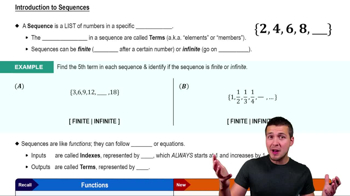
  • How do you identify whether a sequence is finite or infinite based on its notation?

    A sequence is infinite if it ends with an ellipsis (...), indicating it continues indefinitely. If the sequence stops at a specific term without an ellipsis, it is finite.
  • What is the main difference between the inputs for functions and sequences when using their formulas?

    Functions can accept any real number as input, while sequences only use positive integers as indexes. This means sequences are defined for discrete values, not continuous ones.
  • How does a recursive formula for a sequence differ from a general (explicit) formula?

    A recursive formula calculates each term based on previous terms, while a general formula allows direct calculation of any term using its index n. Recursive formulas require knowledge of earlier terms to find later ones.
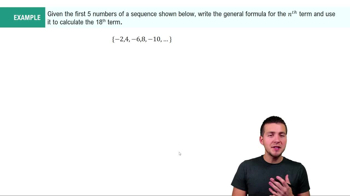
  • What pattern in a sequence suggests the use of negative one raised to a power in its general formula?

    If the sequence alternates between positive and negative values, such as -5, 5, -5, 5, the general formula will include (-1)ⁿ or (-1)ⁿ⁺¹. This causes the sign to flip with each term.
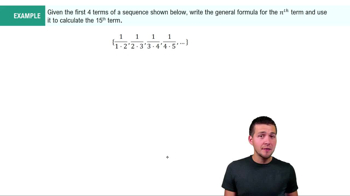
  • When constructing a general formula for a sequence with fractional terms, what should you examine in the numerators and denominators?

    You should look for patterns in how the numerators and denominators change, such as both increasing by 1 or having a constant difference. Adjust the formula by adding or subtracting constants to match the starting values.
  • What type of sequence is indicated when the differences between terms are not constant but instead grow rapidly, such as 2, 4, 8, 16?

    This pattern indicates an exponential sequence, where each term is a constant base raised to the power of n. The general formula will involve an expression like aₙ = bⁿ, with b as the base.