Solving Exponential and Logarithmic Equations definitions Flashcards
Solving Exponential and Logarithmic Equations definitions
You can tap to flip the card.
Control buttons has been changed to "navigation" mode.
1/15
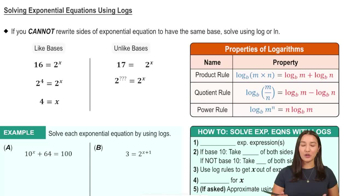
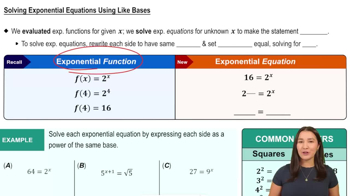
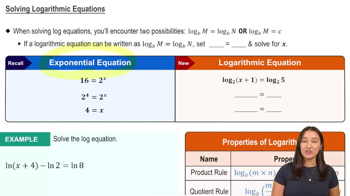
Exponential EquationAn equation where the variable appears in the exponent, often requiring base rewriting or logarithms to solve.Logarithmic EquationAn equation involving a logarithm of a variable, solved by equating arguments or converting to exponential form.BaseThe constant value that is raised to a power in exponential or logarithmic expressions.ExponentThe power to which a base is raised, often containing the variable to be solved in exponential equations.Natural LogarithmA logarithm with base e, commonly denoted as ln, used when the exponential base is not 10.Common LogarithmA logarithm with base 10, denoted as log, typically used when the exponential base is 10.Power RuleA logarithmic property allowing exponents inside a log to be moved in front as a multiplier.Quotient RuleA logarithmic property stating that the log of a quotient equals the difference of the logs.Exponential FormA way of expressing a logarithmic equation as a base raised to an exponent equals a value.Logarithmic FormA way of expressing an exponential equation as a log with a specific base and argument.Isolating the Exponential ExpressionThe process of rearranging an equation so the exponential term stands alone on one side.Argument of a LogarithmThe value or expression inside a logarithm, which must always be positive for real solutions.Like BasesA situation where both sides of an equation share the same base, allowing exponents to be set equal.Linear EquationAn equation of the first degree, often resulting from setting exponents or log arguments equal.Undefined LogarithmA situation occurring when the argument of a log is zero or negative, making the expression invalid.