Skip to main content
Precalculus
My Course
Learn
Exam Prep
AI Tutor
Study Guides
Flashcards
Explore
Try the app
My Course
Learn
Exam Prep
AI Tutor
Study Guides
Flashcards
Explore
Try the app
Back
Solving Trigonometric Equations Using Identities definitions
You can tap to flip the card.
Trigonometric Equation
You can tap to flip the card.
👆
Trigonometric Equation
An expression involving trigonometric functions set equal to a value, requiring solutions for angle values that satisfy the equality.
Track progress
Control buttons has been changed to "navigation" mode.
1/15
Related flashcards
Related practice
Recommended videos
Solving Trigonometric Equations Using Identities quiz
Solving Trigonometric Equations Using Identities
15 Terms
Solving Trigonometric Equations Using Identities
12. Trigonometric Identities
3 problems
Topic
Double Angle Identities
12. Trigonometric Identities
4 problems
Topic
12. Trigonometric Identities
4 topics
8 problems
Chapter
Guided course
4:42
Solve Trig Equations Using Identity Substitutions
1341
views
33
rank
Terms in this set (15)
Hide definitions
Trigonometric Equation
An expression involving trigonometric functions set equal to a value, requiring solutions for angle values that satisfy the equality.
Trigonometric Identity
A universally true relationship between trigonometric functions, used to simplify or transform equations.
Pythagorean Identity
A fundamental relationship connecting the squares of sine, cosine, or tangent functions, often used to rewrite expressions.
Double Angle Identity
A formula expressing a trigonometric function of twice an angle in terms of functions of the original angle.
Even-Odd Identity
A property describing how trigonometric functions behave when their input is negated, distinguishing between even and odd functions.
Unit Circle
A circle of radius one centered at the origin, providing reference values for trigonometric functions at key angles.
General Solution
A formula that includes all possible angle values satisfying a trigonometric equation, often using a periodic term.
Secant
A trigonometric function defined as the reciprocal of cosine, often appearing in equations requiring simplification.
Tangent
A trigonometric function representing the ratio of sine to cosine, frequently used in solving equations.
Sine
A trigonometric function giving the y-coordinate of a point on the unit circle corresponding to a given angle.
Cosine
A trigonometric function giving the x-coordinate of a point on the unit circle corresponding to a given angle.
Linear Trigonometric Equation
An equation involving a single trigonometric function of an angle, set equal to a constant, and solvable using the unit circle.
Argument
The input value, typically an angle, for a trigonometric function, which can be manipulated using identities.
Periodicity
A property of trigonometric functions where values repeat at regular intervals, crucial for finding all solutions.
Angle
A measure, usually in radians or degrees, representing the rotation from the positive x-axis, central to trigonometric equations.
 BackBack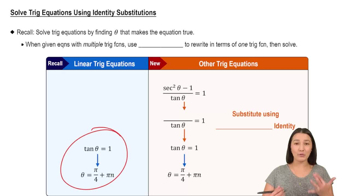
 4:42
4:42