Skip to main content
Precalculus
My Course
Learn
Exam Prep
AI Tutor
Study Guides
Flashcards
Explore
Try the app
My Course
Learn
Exam Prep
AI Tutor
Study Guides
Flashcards
Explore
Try the app
Back
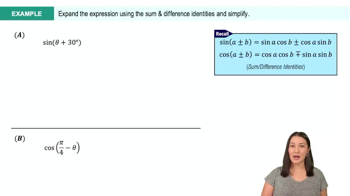
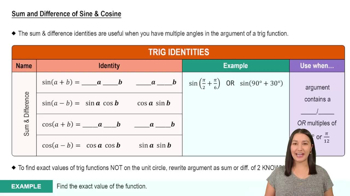
Sum and Difference Identities definitions
You can tap to flip the card.
Sum and Difference Identities
You can tap to flip the card.
👆
Sum and Difference Identities
Formulas that express trig functions of sums or differences of angles in terms of functions of individual angles.
Track progress
Control buttons has been changed to "navigation" mode.
1/15
Related flashcards
Related practice
Recommended videos
Sum and Difference Identities quiz
Sum and Difference Identities
15 Terms
Sum and Difference Identities
12. Trigonometric Identities
5 problems
Topic
Double Angle Identities
12. Trigonometric Identities
4 problems
Topic
12. Trigonometric Identities
4 topics
8 problems
Chapter
Guided course
4:47
Sum and Difference of Tangent
1035
views
19
rank
Guided course
2:42
Sum and Difference of Sine & Cosine Example 3
886
views
26
rank
Guided course
06:14
Sum and Difference of Sine & Cosine
1887
views
62
rank
1
comments
Terms in this set (15)
Hide definitions
Sum and Difference Identities
Formulas that express trig functions of sums or differences of angles in terms of functions of individual angles.
Sine Sum Identity
Formula expanding the sine of a sum into products of sines and cosines of the individual angles.
Sine Difference Identity
Formula expanding the sine of a difference into products of sines and cosines of the individual angles, with a sign change.
Cosine Sum Identity
Formula expressing the cosine of a sum as the difference of products of cosines and sines of the angles.
Cosine Difference Identity
Formula expressing the cosine of a difference as the sum of products of cosines and sines of the angles.
Tangent Sum Identity
Formula expressing the tangent of a sum as a quotient involving the tangents of the individual angles.
Tangent Difference Identity
Formula expressing the tangent of a difference as a quotient involving the tangents of the individual angles, with sign changes.
Unit Circle
A circle of radius one centered at the origin, used to define exact values of trig functions for standard angles.
Quadrant
One of four regions in the coordinate plane, used to determine the sign of trig values based on angle location.
Cofunction Identity
Relationship showing how trig functions of complementary angles are related, often verified using sum and difference identities.
Verification
Process of simplifying one or both sides of a trig equation to show equality, often using identities.
Pythagorean Theorem
Relationship among the sides of a right triangle, used to find missing side lengths when solving trig problems.
Exact Value
A non-decimal, simplified result for a trig function, often involving radicals or fractions, not approximated numerically.
Special Right Triangle
A triangle with angle measures and side ratios that are commonly used to quickly find trig values.
Argument
The angle or expression inside a trig function, which may be a sum or difference of two angles.
 BackBack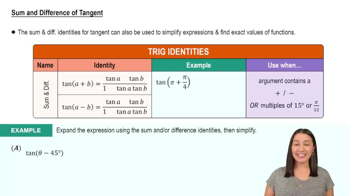
 4:47
4:47