Skip to main content
Precalculus
My Course
Learn
Exam Prep
AI Tutor
Study Guides
Flashcards
Explore
My Course
Learn
Exam Prep
AI Tutor
Study Guides
Flashcards
Explore
Back
Transformations definitions
You can tap to flip the card.
Transformation
You can tap to
flip the card.
👆
Transformation
Any change to a function's graph or equation that alters its position or shape, such as shifting, reflecting, or stretching.
Track progress
Control buttons has been changed to "navigation" mode.
1/15
Related flashcards
Related practice
Recommended videos
Guided course
5:25
Intro to Transformations
Patrick
2197
views
79
rank
2
comments
Guided course
5:00
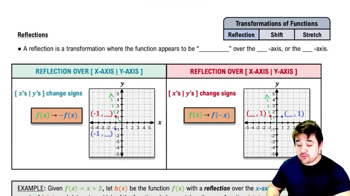
Reflections of Functions
Patrick
1414
views
48
rank
Guided course
01:09
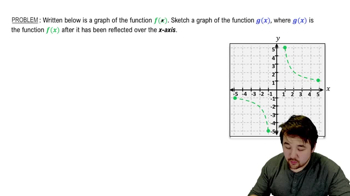
Reflections of Functions Example 1
Patrick
1114
views
34
rank
Terms in this set (15)
Hide definitions
Transformation
Any change to a function's graph or equation that alters its position or shape, such as shifting, reflecting, or stretching.
Reflection
A flip of a graph over a specific axis, resulting in a mirror image and changing the sign of certain values.
Shift
A movement of a graph horizontally, vertically, or both, relocating every point without altering the graph's shape.
Stretch
An alteration that increases the distance between points on a graph, making it appear taller or wider.
Compression
A transformation that decreases the distance between points on a graph, making it appear shorter or narrower.
Horizontal Shift
A movement of a graph left or right, determined by changes inside the function's argument.
Vertical Shift
A movement of a graph up or down, determined by changes added outside the function.
Horizontal Stretch
A widening of a graph along the x-axis, caused by multiplying the input by a constant between 0 and 1.
Vertical Stretch
An elongation of a graph along the y-axis, caused by multiplying the output by a constant greater than 1.
Horizontal Compression
A narrowing of a graph along the x-axis, caused by multiplying the input by a constant greater than 1.
Vertical Compression
A flattening of a graph along the y-axis, caused by multiplying the output by a constant between 0 and 1.
Domain
The complete set of possible input values for a function, which may change after a transformation.
Range
The complete set of possible output values for a function, which can be altered by transformations.
Function Notation
A symbolic way to represent transformations, such as f(x-h)+k for shifts or cf(x) for stretches.
Combination of Transformations
The sequential application of multiple transformations to a function, affecting both its graph and equation.
 Back
Back
 Back
Back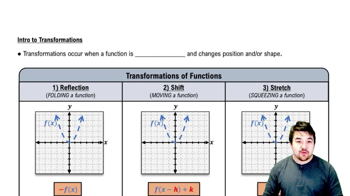
 5:25
5:25