Skip to main content
Precalculus
My Course
Learn
Exam Prep
AI Tutor
Study Guides
Flashcards
Explore
Try the app
My Course
Learn
Exam Prep
AI Tutor
Study Guides
Flashcards
Explore
Try the app
Back
Graphs and Properties of Sine and Cosine Functions
You can tap to flip the card.
Domain of sine and cosine functions
You can tap to flip the card.
👆
Domain of sine and cosine functions
The domain of both sine and cosine functions is the set of all real numbers.
Track progress
Control buttons has been changed to "navigation" mode.
1/20
Recommended videos
5:05
Amplitude and Reflection of Sine and Cosine
1888
views
56
rank
2:18
Example 1
1644
views
43
rank
1
comments
5:53
Graph of Sine and Cosine Function
3315
views
101
rank
1
comments
Terms in this set (20)
Hide definitions
Domain of sine and cosine functions
The domain of both sine and cosine functions is the set of all real numbers.
Range of sine and cosine functions
The range of sine and cosine functions is all real numbers from −1 to 1, inclusive.
Period of sine and cosine functions
Both sine and cosine functions have a period of \(2\pi\).
Symmetry of sine function
The sine function is an odd function, symmetric with respect to the origin.
Symmetry of cosine function
The cosine function is an even function, symmetric with respect to the y-axis.
Maximum and minimum values of sine and cosine
Both sine and cosine functions have a maximum value of 1 and a minimum value of −1.
Key x-intercepts of sine function
The sine function has x-intercepts at \(0, \pi, 2\pi\) and multiples thereof.
Key x-intercepts of cosine function
The cosine function has x-intercepts at \(\frac{\pi}{2}, \frac{3\pi}{2}\) and odd multiples thereof.
Effect of amplitude on sine and cosine graphs
Amplitude
A
stretches the graph vertically by a factor of
|A|
, changing the range to [−|A|, |A|].
Effect of frequency (omega) on period
For functions of the form
y = A sin(ωx)
or
y = A cos(ωx)
, the period is \(\frac{2\pi}{\omega}\).
Graphing sine function using key points
Divide one period into four equal subintervals to find five key points for plotting the sine curve.
Graphing cosine function using key points
Divide one period into four equal subintervals to find five key points for plotting the cosine curve.
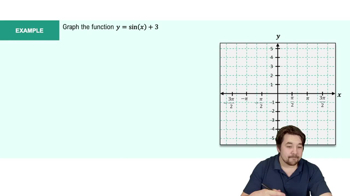
Vertical shift in sinusoidal functions
Adding a constant
D
to
y = A sin(ωx) + D
or
y = A cos(ωx) + D
shifts the graph vertically by
D
units.
Horizontal compression/stretch in sinusoidal functions
Multiplying the input by
ω
compresses the graph horizontally by a factor of
1/ω
.
Equation form of sinusoidal functions
General form:
y = A sin(ωx + φ) + D
or
y = A cos(ωx + φ) + D
, where
φ
is phase shift.
Amplitude from sinusoidal equation
The amplitude is the absolute value of
A
in the sinusoidal function.
Period from sinusoidal equation
The period is calculated as \(\frac{2\pi}{|\omega|}\).
Finding sinusoidal equation from graph
Identify amplitude, period, phase shift, and vertical shift from the graph to write the equation.
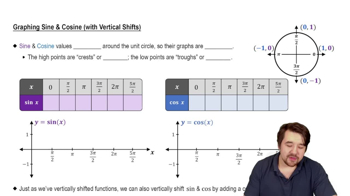
Sine function key points in one period
At \(0, \frac{\pi}{2}, \pi, \frac{3\pi}{2}, 2\pi\), sine values are 0, 1, 0, −1, 0 respectively.
Cosine function key points in one period
At \(0, \frac{\pi}{2}, \pi, \frac{3\pi}{2}, 2\pi\), cosine values are 1, 0, −1, 0, 1 respectively.
 BackBack
 5:05
5:05