Skip to main content
Precalculus
My Course
Learn
Exam Prep
AI Tutor
Study Guides
Flashcards
Explore
Try the app
My Course
Learn
Exam Prep
AI Tutor
Study Guides
Flashcards
Explore
Try the app
Back
One-to-One and Inverse Functions - Precalculus
You can tap to flip the card.
What is a one-to-one function?
You can tap to flip the card.
👆
What is a one-to-one function?
A function is
one-to-one
if any two different inputs correspond to two different outputs.
Track progress
Control buttons has been changed to "navigation" mode.
1/20
Recommended videos
5:10
Finding the Domain and Range of a Graph
3290
views
125
rank
1
comments
5:38
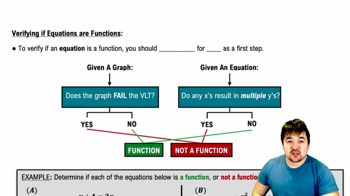
Verifying if Equations are Functions
3623
views
148
rank
3
comments
5:20
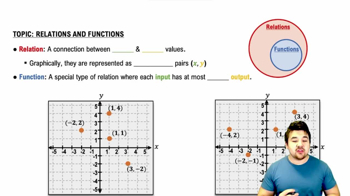
Relations and Functions
7519
views
292
rank
Terms in this set (20)
Hide definitions
What is a one-to-one function?
A function is
one-to-one
if any two different inputs correspond to two different outputs.
What does the horizontal-line test determine?
If every horizontal line intersects the graph of a function at most once, the function is
one-to-one
.
How can you tell if a function is one-to-one from its graph?
If no horizontal line intersects the graph more than once, the function is
one-to-one
.
What is the relationship between increasing/decreasing functions and one-to-one functions?
A function that is
increasing
or
decreasing
on an interval is
one-to-one
on that interval.
What is the inverse function of a one-to-one function f?
The inverse function, denoted \(f^{-1}\), reverses the mapping of f from range to domain.
How do you find the inverse of a function defined by a map?
Interchange the elements in the domain and range pairs to get the inverse function.
What is the domain of the inverse function relative to the original function?
The domain of the inverse function is the range of the original function.
What is the range of the inverse function relative to the original function?
The range of the inverse function is the domain of the original function.
How are the graphs of a one-to-one function and its inverse related?
They are symmetric with respect to the line \(y=x\).
How do you graph the inverse function from the graph of f?
Reflect the graph of f about the line \(y=x\).
What is the procedure to find the inverse of a one-to-one function defined by an equation?
Step 1: Replace f(x) with y. Step 2: Interchange x and y. Step 3: Solve for y to get the inverse function.
How do you verify that two functions are inverses?
Show that \(f(g(x))=x\) and \(g(f(x))=x\) for all x in their domains.
What do you do if a function is not one-to-one on its entire domain?
Restrict the domain to an interval where the function is increasing or decreasing to make it one-to-one.
How do you find the inverse of a domain-restricted function?
Interchange x and y, solve for y, and consider the domain restriction to select the correct inverse branch.
What is the inverse of the function \(f(x) = 3x - 5\)?
The inverse is \(f^{-1}(x) = \frac{x + 5}{3}\).
What does it mean for a function to fail the horizontal-line test?
It means the function is not one-to-one because some horizontal lines intersect the graph more than once.
What is the domain and range of the inverse function if the original function's domain is states and range is populations?
The inverse function's domain is populations and its range is states.
Why is the graph of the inverse function a reflection about y = x?
Because the inverse swaps the roles of inputs and outputs, reflecting points across the line y = x.
What is the significance of the line y = x in inverse functions?
It is the line of symmetry between a function and its inverse.
How do you check the inverse function of \(f(x) = \sqrt{x-1}\) when domain is restricted to x ≥ 0?
Verify that \(f(f^{-1}(x)) = x\) and \(f^{-1}(f(x)) = x\) hold for the restricted domain.
 BackBack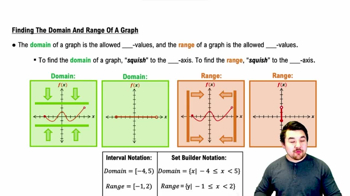
 5:10
5:10